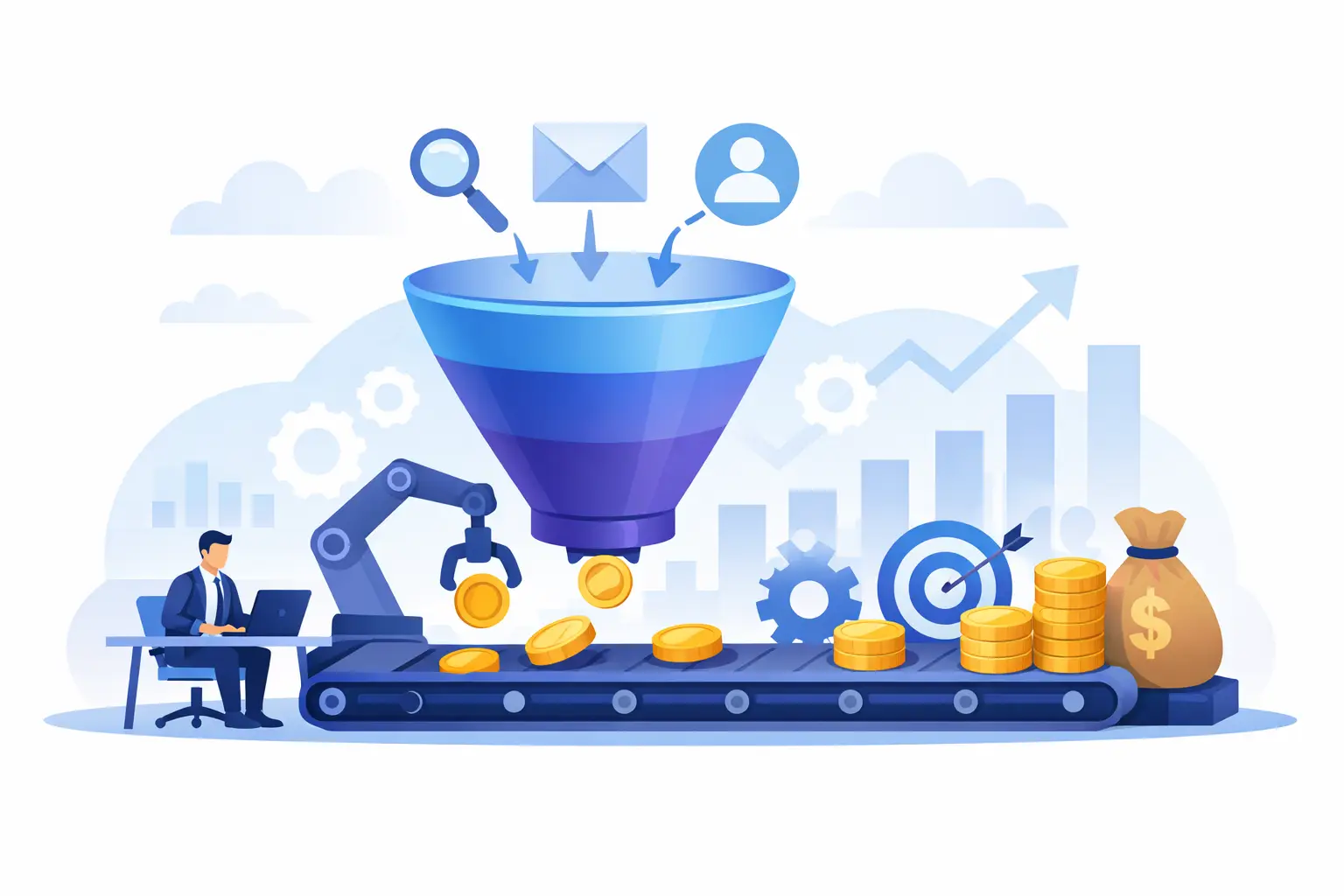
A sales funnel that generates leads, qualifies them, and guides them through to the sale isn't just a page with a form. It's a digital sales system. That's why, when asked How much does an automated funnel cost?, the honest answer isn't a simple number: it depends on how much work it has to do for you, how many steps you currently handle manually, and the value of each acquired customer.
The problem is that many companies buy the cheapest version, thinking they’ve solved their lead generation problem. Then they receive a few unfiltered inquiries, respond late, lose out on hot leads, and conclude that “the funnel isn’t working.” It wasn’t a funnel. It was a landing page left to fend for itself.
How Much Does an Automated Funnel Cost: The Actual Price Ranges
An automated funnel can cost anywhere from a few hundred euros a month to several thousand, or it may require a significant upfront investment. The difference doesn’t depend on whether the design is more or less modern. It depends on the depth of the infrastructure: strategy, copy, pages, CRM, tracking, automation, messaging, integrations, and optimization.
For a local business or a professional with a clear offering, a basic sales funnel can cost roughly between 500 and 1,500 euros to set up. This price range typically includes a landing page, a contact form, a confirmation page, basic integration with a CRM, and a few automated emails. It’s enough to start collecting leads, but don’t expect it to be a fully automated sales machine.
A more structured sales funnel—designed to generate leads through advertising campaigns and manage a lead qualification phase—can cost between 2,000 and 7,000 euros to set up. This involves analyzing the offering, writing persuasive copy, creating multiple pages, setting up booking calendars, segmenting contacts, following up via email or WhatsApp, dashboards, and event tracking.
For companies with complex sales, multiple services, multiple locations, sales teams, or long purchasing cycles, the bill can exceed 10,000 euros. Not because someone decided to inflate the quote, but because processes need to be designed: lead assignment, CRM pipeline, scoring, reminders, resuming stalled negotiations, integration with management systems, and reliable reporting.
The point is simple: you're not buying a funnel designed in software. You're building a process that needs to turn leads into appointments and appointments into revenue.
The Costs You Often Don't See in the Estimate
The cost of building it is only part of the story. A serious automated funnel relies on tools and maintenance. If these elements are missing, after a few months you’ll end up with a structure that may exist, but doesn’t convert—and no one can explain why.
There are four areas to consider: software, traffic, operational management, and optimization. CRM, email marketing, booking systems, chatbots (if used), and platform connectors almost always come with a subscription fee. For a small business, software costs can remain modest. For a company with large databases, multiple agents, and advanced automation, however, they rise rapidly.
Then there’s traffic. A funnel without qualified visitors is like a perfect store built on a deserted street. If you use Google Ads, Meta Ads, or TikTok Ads, the advertising budget isn’t included in the technical cost of the funnel. It needs to be planned separately, with a realistic goal and room to test creative concepts, audiences, and messaging.
The third point is management. Offers change, contacts ask new questions, an integration may stop working, a page may slow down, and the cost per lead may rise. Someone who delivers the project and then disappears leaves you to deal with the problem just when the useful data starts coming in.
Finally, there’s optimization. The first version is almost never the one that produces the best results. Changing a headline, revising a form question, shortening the booking process, or modifying the follow-up sequence can make a huge difference. But it requires ongoing analysis and adjustments—not a one-time effort.
One-time setup fee or monthly subscription?
The traditional model is clear: you pay for a project, receive web pages and automations, and then every change becomes a new negotiation. It can make sense if you already have an in-house marketing department capable of analyzing data, updating content, and coordinating with technical staff, advertisers, and salespeople. For many small and medium-sized businesses, however, it’s like buying a race car without a driver or a mechanic.
The monthly fee spreads out the investment and keeps the system running. Instead of incurring a high upfront cost, you have a more predictable expense that includes development, support, modifications, and improvements based on the plan you choose. It isn’t automatically the absolute cheapest solution, but it’s often the least risky one: it prevents you from tying up budget in a project that remains unchanged while the market evolves.
This approach works best when the funnel is part of an ongoing strategy. If you invest in advertising, for example, you generate data every month that you can use to make adjustments. Leaving the system unchanged is like paying to learn and then ignoring what you’ve learned.
WebWakeUp operates precisely on this principle: rather than simply delivering a digital solution and walking away, it acts as an external technical and marketing department that maintains an operational, growth-oriented infrastructure.
What Really Determines the Estimate
Two businesses may request a “sales funnel” and receive very different quotes—both of which are correct. A dentist looking to schedule appointments for a specific treatment follows a relatively straightforward path. A B2B company that sells consulting services, equipment, or high-value services, on the other hand, must deal with multiple decision-makers, lengthy timelines, and complex sales processes.
The key factors are the value of the offering, the number of services to be promoted, the level of automation required, and the quality of the assets already available. If you already have testimonials, case studies, a clear positioning, and a salesperson who closes deals effectively, the funnel can focus on acquisition. If the offer is unclear or indistinguishable from competitors’, you’ll first need a strategic work. And that work isn't just an extra: it's what prevents you from paying for traffic based on a flimsy promise.
The acquisition channel matters, too. The funnel for people coming from Google with an immediate need is different from the one for people you reach on Meta while they’re scrolling through content. In the first case, you need to answer a question that’s already top of mind. In the second, you need to build awareness, trust, and desire. Same pages? No. Same budget? Hardly.
How to Tell If the Cost Is Sustainable
The right question isn’t “How much does it cost?” It’s “How many additional customers does it need to generate to pay for itself?” If your average margin per customer is 1,000 euros and the system costs 1,500 euros per month for management, tools, and traffic, you only need two additional customers to cover the investment and start generating profit. If the margin is 150 euros, the math changes: you’ll need to focus on volume, repeat purchases, and much lower acquisition costs.
Base your calculations on four key metrics: average margin per sale, sales close rate, customer lifetime value, and the team’s actual capacity to handle inquiries. A sales funnel can increase leads, but if no one follows up within a reasonable timeframe or the sales team doesn’t manage the pipeline, you’re paying to fill a bucket with a hole in it.
Be wary of both prices that are too low and absolute promises. An offer for just a few hundred euros that includes strategy, design, copy, CRM, automation, advertising, and guaranteed results is almost certainly cutting corners. Often, it cuts out the invisible part that really matters: analysis, tracking, and optimization.
When It's Not Yet Worth Investing
A sales funnel won’t save an offer that no one is interested in, a service with no profit margin, or a team that doesn’t have time to talk to potential customers. Before you automate, you need to have a clear value proposition, a basic sales process, and the ability to deliver on your promises.
There’s no need to wait until you’re perfect. What you need to do is avoid letting chaos take over. If leads come in via WhatsApp today, get forgotten, and no one knows which channel they came from, the priority is to bring order to the process. Even a basic, well-defined, and simple initial funnel can be the step that transforms a random lead generation into a manageable process.
The right price isn't the lowest one on the quote. It's the one that—based on the numbers—allows you to stop giving away leads to competitors and to build a system that improves month after month.