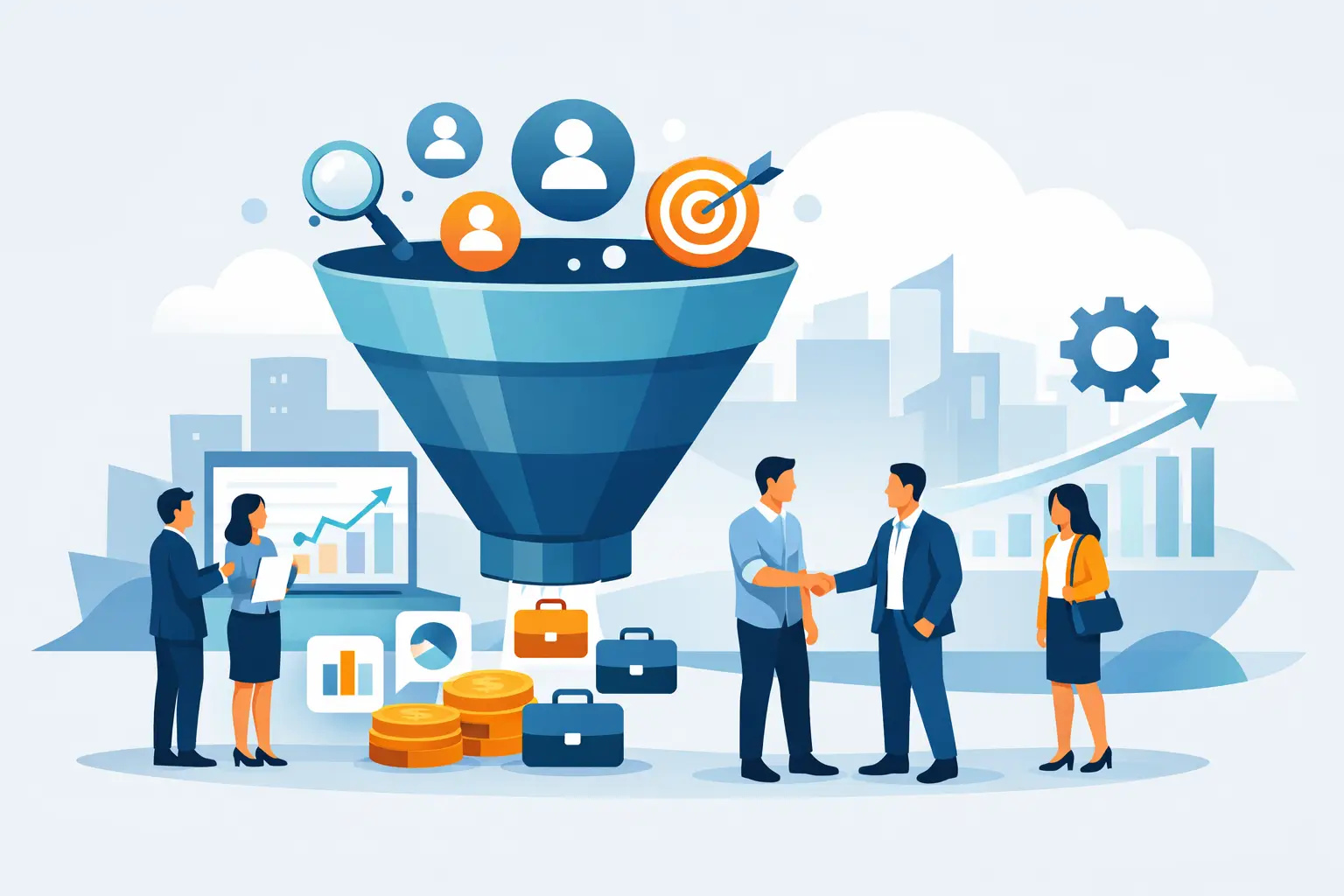
A lead who downloads a brochure and then doesn’t respond is not a win. It’s a cost. A useful guide to B2B lead generation starts here: you don’t need to collect names; you need to create a system that generates conversations with companies that have a real problem, a compatible budget, and a concrete reason to choose you.
In B2B, the sales cycle is longer, the people involved are different, and trust matters more than a catchy headline. That’s why copying an e-commerce funnel or buying traffic to the homepage is a surefire way to waste your budget. Lead generation works when marketing, the website, CRM, and sales all work toward the same goal: turning attention into measurable opportunities.
A Guide to B2B Lead Generation: Start with Your Offering, Not Your Ads
Advertising won't fix a confusing offer. If visitors to your site don't understand within a few seconds who you work for, what results you deliver, and why they should trust you, the campaign may generate clicks but not customers.
First, define the type of company you want to target. It’s not enough to simply say “SMEs.” A software company targeting manufacturing firms with 20 to 100 employees faces different dynamics, objections, and purchasing timelines than an HR consultant selling to professional firms. The more precise the target, the more effective your message, content, and investment will be.
Next, clarify your sales pitch. Don’t sell a generic service like “marketing consulting” or “web development.” Sell the problem you solve and the outcome you make more likely: reducing the time it takes to prepare quotes, generating qualified leads, lowering operating costs, or getting more inquiries in a specific area or industry.
Note: An aggressive claim without evidence breeds skepticism. In B2B, it’s best to be specific rather than sensationalist. Numbers, methodology, use cases, implementation timelines, and access conditions make your offer credible. If you don’t yet have significant case studies, use concrete examples of processes and highlight your vertical expertise.
Build a funnel that filters, not a form that collects everything
The B2B sales funnel shouldn't aim to maximize the number of leads. It should aim to maximize the proportion of leads that the sales rep can profitably follow up on. These are two very different goals.
The basic structure is simple: a traffic source intercepts a request, a landing page It builds on the message; a conversion brings the lead into the CRM, and a follow-up sequence guides the decision-making process. The problem arises when any of these steps is treated as a technical detail.
An effective landing page isn’t one filled with flashy effects. It must answer the questions potential customers are actually asking themselves: Is this right for my business? What results can I expect? How does it work? How much effort does it require? Why should I work with you specifically? Include a call to action that aligns with the visitor’s level of awareness. If the offer is complex and the price point is high, asking for an introductory call can be effective. If the audience is unengaged, it’s often more realistic to first offer an analysis, a diagnosis, or a highly targeted practical resource.
The form should be designed to qualify leads. Asking only for name, email, and phone number increases the volume of leads but shifts the filtering work to the sales team. Asking for ten fields blocks conversions. The solution lies somewhere in the middle: collect the information that truly changes the lead’s priority, such as industry, company size, primary need, and timeframe.
Don’t hide the fact that you want to sell. A B2B company doesn’t fill out a form just for fun. Explain what will happen after they submit it: they’ll receive an assessment, be contacted within a specified timeframe, and be able to schedule a meeting. Clarity weeds out the casual browsers and speeds up the process for serious prospects.
Choose channels based on demand, not trends
Google Ads often captures a search query that’s already in progress. If a decision-maker is looking for a supplier, a solution, or a quote, this channel can generate high-intent inquiries. However, the cost per click can be high, and overly generic keywords attract companies outside the target audience. Here, quality depends on the selection of queries, messaging, and landing pages—not simply on increasing the budget.
LinkedIn is useful when you need to target specific roles, industries, or companies. It works well for complex services, account-based marketing, and campaigns that build authority before reaching out. On the other hand, it requires credible creativity and a well-tailored offer: B2B decision-makers can spot a cookie-cutter ad right away.
Meta Ads can be effective for expanding demand, doing remarketing, and distributing content that shifts perceptions of the issue. It’s not the place where you should always expect users to be ready to buy. If you use it like Google, you risk misjudging it. If you use it to nurture your audience and re-engage those who have already visited key pages, it can lower your customer acquisition cost over time.
Email marketing rounds out the system, especially when a decision takes weeks or months. A useful sequence doesn’t just send three messages asking, “Have you seen our offer?” It addresses objections, showcases use cases, explains common mistakes, and creates legitimate opportunities to reopen a conversation.
Speed and Follow-Up: Where Revenue Is Lost
Many companies pay to generate leads and then let them sit unused in an email inbox. It’s a costly contradiction. A prospect who’s interested today may be unreachable tomorrow—or may have already spoken with a competitor who acted faster.
CRM is designed to prevent this from happening. Every lead must be entered with its source, campaign, conversion page, qualification data, and sales status. Without this information, you won’t know whether a campaign is generating real opportunities or just form submissions.
Automation doesn't replace a consultative sales approach. However, it eliminates delays and repetitive tasks: immediate lead assignment, confirmation replies, reminders for sales reps, notifications about hot leads, follow-ups after a missed call, and updates to the stages of negotiation. The result is not an impersonal process. It is a process in which no one is forgotten.
Also establish a clear rule for handling inquiries. For some high-interest opportunities, making initial contact within a few minutes drastically changes the likelihood of securing a meeting. For others, a response within the same business day is sufficient. It depends on the industry, the value of the sale, and the type of inquiry. What never works is not having a standard.
Measure what contributes to revenue
Cost per lead is an incomplete metric. A 15-euro lead that doesn’t respond costs more than a 90-euro lead that becomes a customer. The right question isn’t “How many leads have we generated?”, but “How many qualified opportunities have we created, and how much does it cost us to acquire a customer?”.
Track the entire sales funnel: qualified traffic, landing page conversions, qualified leads, scheduled appointments, completed appointments, open deals, and closed contracts. If the volume is low, also pay attention to sales conversations and recurring objections. Often, the problem isn’t the channel, but a mismatch between the ad’s promise and the proposal made during the call.
Here’s a simple example: a campaign generates 40 leads per month. Only 12 respond to the initial contact, 6 schedule a call, 4 are qualified, and 1 becomes a customer. If the customer value and the margin justify the investment, the system makes sense. If they don’t, there’s no point in celebrating the 40 leads: you need to address your targeting, qualification, offer, or sales process.
Mistakes That Make B2B Lead Generation Seem Ineffective
The first is to leave everything up to the campaign. Advertising brings people to your offer, but it can't fix a slow website, a generic landing page, a calendar with no availability, or a sales rep who calls back three days later.
The second is to change your strategy every week. Campaigns need data, but they don’t need to remain static. Test one element at a time: segment, message, offer, landing page, or call to action. If you change everything at once, you’ll never know what improved or worsened the results.
The third issue is working in silos. Those who manage advertising, those who update the website, those who use the CRM, and those who handle sales all need to see the same data. Otherwise, the marketing team will optimize based on form submissions, the sales team will complain about the quality of the leads, and the business owner will pay out without a clear understanding of the return on investment.
This is where a technical department and external marketing, which operates continuously as WebWakeUp, can make all the difference: it doesn't just deliver a landing page and disappear, but keeps the infrastructure, campaigns, automations, and sales data all connected.
B2B lead generation isn’t a machine you turn on once. It’s a system you refine every month. When you stop chasing random leads and start managing demand, response time, and the quality of opportunities, digital marketing stops being an expense you have to justify and becomes a tool your business can truly leverage.