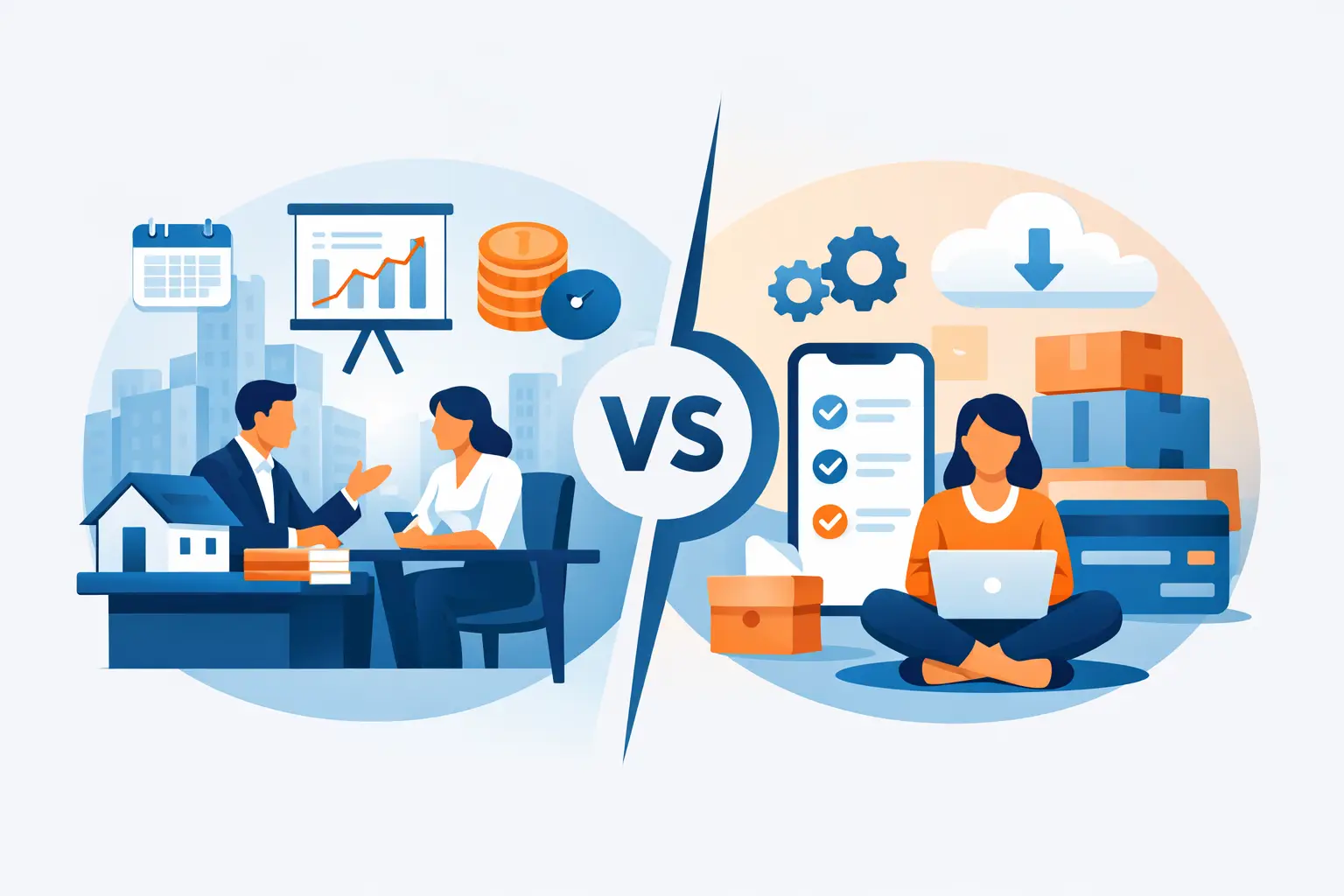
If you’re wondering today whether to go with a traditional agency or a subscription service, the point isn’t which option sounds better. The point is which model brings you customers, helps you avoid mistakes, and doesn’t leave you on your own after delivery. Because a website that’s launched and then abandoned isn’t a digital investment. It’s a cost disguised as a finished project.
Many Italian companies have been through this before. They pay for a website, a landing page, or a one-time campaign; they receive the work—which may even be well done—and after a few weeks, the operational void sets in. Need a change? A new quote is drawn up. Need to improve conversions? It gets put off. Need to integrate CRM, automation, or advertising? You start from scratch. Meanwhile, competitors keep moving forward.
The real choice, then, is neither aesthetic nor theoretical. It’s a structural choice. Do you want a vendor who delivers a project, or a partner who oversees your digital ecosystem as your business moves forward?
Traditional Agency or Subscription: The Real Difference
Traditional agencies often work on a project-by-project basis. They define the scope, prepare a quote, develop the project, deliver it, and close the project. This model follows a clear logic and works in some cases, especially when you have a one-off, well-defined need and your company already has someone handling marketing, updates, analysis, and optimization.
The problem arises when a project is expected to generate results over time. A website doesn’t perform well just because it exists. A campaign doesn’t yield results just because it’s been launched. A landing page doesn’t convert by magic. All of this needs to be monitored, adjusted, tested, optimized, integrated with the right tools, and adapted to real-world data.
The subscription model starts here. It doesn’t just sell the delivery of a digital asset. It sells operational continuity. In short, you’re not just buying a website. You’re setting up an external team that works on your online presence, lead generation, technical updates, automation, and ongoing support.
This difference changes everything, especially for entrepreneurs, professionals, and small and medium-sized businesses that don't have the time or resources to build an in-house team.
When a Traditional Agency Really Makes Sense
To say that the traditional model is always wrong would be a convenient but false oversimplification. It makes sense if you have very specific and limited objectives. For example, if you need to carry out a self-contained project with stable requirements that doesn’t require frequent updates. Or if you already have an in-house marketing manager, a technical department, and a structure capable of further developing that work after delivery.
In that case, you pay for a deliverable, receive it, and manage it internally. That's it.
But this isn't the case for most Italian businesses. Many companies don't have a team that handles analytics, UX, campaigns, funnel, CRM, tracking, maintenance, and automation. They have a much more concrete priority: acquiring customers without turning into a software company or an agency of their own.
And this is where the traditional model begins to reveal its most costly limitation. Not the initial price. The cost of everything that remains uncovered afterward.
The Problem with One-Time Projects
A one-time project seems reassuring because it has a start, a budget, and an end. You know how much you’re spending from the outset, and—on paper—many entrepreneurs like that. But the digital world doesn’t operate on static deliverables. It operates through iteration.
A website needs to be fixed when users aren’t converting. Pages need to be updated when the offering changes. Campaigns need to be optimized when the cost per lead rises. The CRM needs to be adjusted when sales reps lose leads along the way. Automations are needed when manual work becomes a bottleneck.
If every minor change triggers a new round of negotiations, the result is always the same: delays, friction, a fragmented budget, and postponed decisions. Not because of a lack of will, but because every step becomes a separate purchase.
And while you put things off, you're missing out on opportunities. Not just in theory—but in revenue.
Why Subscription Services Appeal to Those Who Focus on the Numbers
The biggest advantage of the subscription model isn't just financial. It's operational. It transforms digital from an intermittent expense into a continuous operating system.
You have predictable costs, which is already a relief for many businesses. But above all, you have a structure that remains active. This means faster turnaround times, less decision-making friction, greater ease in making changes, and greater consistency across your website, campaigns, sales funnels, tracking, and sales processes.
If your goal is to generate leads and convert them into customers, this consistency is worth more than perfect project achieved only once. Because the result doesn't come from a single brilliant move. It comes from the sum of many well-timed optimizations made at the right moment.
A well-designed subscription model also allows you to reduce perceived risk. You don’t immediately tie up a large portion of your budget in an asset whose performance you don’t yet know. You start, measure, adjust, and scale up. It’s an approach that’s much closer to the reality of business.
Traditional Agency or Subscription: Which Is Best for an SME?
For an SME or a professional looking to attract customers online, the answer depends on three factors: how frequently the need arises, the complexity of the marketing, and the required speed.
If your business changes frequently, if you need active campaigns, Landing page to be tested, with integrations and quick support, a subscription is almost always the smartest choice. Because your problem isn't having a website. It's making sure your digital strategy works every week.
On the other hand, if you have a very stable business, a product or service offering that doesn’t change much, and an internal structure capable of handling everything else, a traditional project approach may be sufficient. But you need to be sure you actually have that structure in place. Many people think they do, only to discover later that no one is actually following through on the next steps.
The right question isn't how much a website or a campaign costs. The right question is: Who will be in charge of it in 30, 60, or 180 days?
Because that's where the return on investment is determined.
The False Savings That Hinder Growth
Many people choose the traditional model thinking they’ll spend less. In some cases, this is true only for the initial payment. Then come revisions, extensions, urgent requests, technical issues, new pages, additions, bugs, business requests, and unanticipated optimizations. And the cost ends up spiraling out of control.
The point isn't to demonize extra estimates. The point is that a model designed to deliver projects isn't meant to support continuous growth. If your business requires constant oversight, any activity outside that scope becomes a hindrance.
A monthly fee, on the other hand, better aligns interests and operations. You need continuity. Your partner is tasked with ensuring it. This doesn’t mean that every subscription is automatically a good fit. It means that the underlying logic is better suited to those who want results over time, rather than just an initial delivery.
How to Figure Out Which Model You Really Need
Take a look at the past six months. Did you need to update your website? Did you launch new offers? Did you request graphic or technical changes? Did you try advertising? Did you lose leads due to a lack of response, organization, or automation? If the answer is “yes” to even half of these questions, you don’t have a one-time need. You have an ongoing need.
And if you have an ongoing need, paying for digital content on a per-item basis is rarely the most efficient option.
A subscription-based partner makes sense when you want to stop managing separate vendors and start working with an organization that brings together development, marketing, performance, and processes. It’s an approach that’s closer to an external department than to a mere service provider.
That’s why companies like WebWakeUp are adopting a model that differs from the traditional closed-project approach. Not because the subscription model is just a fad, but because online growth requires ongoing monitoring, speed, and continuous optimization. Everything else is often just a false start—even if it’s executed well.
The right choice isn't necessarily the easiest one
Choosing between a traditional agency and a subscription model means deciding how you want to approach digital: as a task to check off your list or as a driver of growth. If you just need a single deliverable, the traditional model might work. But if you want visibility, leads, smoother processes, and real support, you need continuity.
The market doesn't reward those who just launch a website and stop there. It rewards those who refine, test, automate, and accelerate while others wait for the next quote. And this isn't a matter of style. It's a matter of sales.