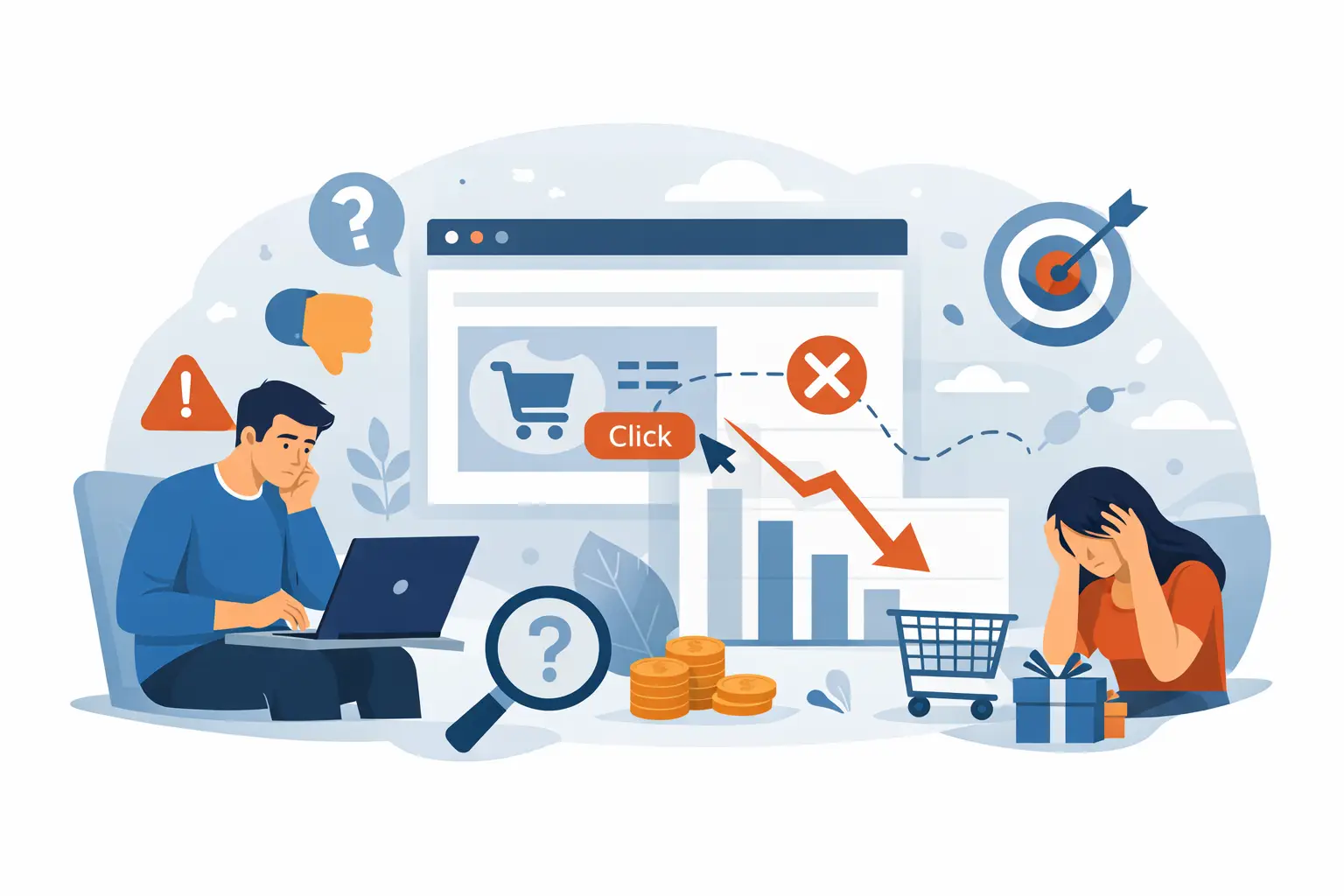
You're paying for clicks, you see traffic coming to your site, but the phone stays silent. Or you get leads asking for information, but they disappear after receiving a quote and never become customers. If you're wondering Why Ads Don't Convert, the answer is rarely “the campaign isn’t working.” More often than not, the campaign is bringing to light a problem that already exists: a weak offer, a page that doesn’t convert, slow lead management, or numbers that have been misinterpreted.
Shutting everything down after two weeks may seem like a safe bet. In reality, without understanding where the process is breaking down, you’re just cutting off an investment before you’ve fixed it. Ads aren’t a magic wand—and they shouldn’t be: they’re an accelerator. If you accelerate a chaotic system, you’ll end up with even more chaos—at a cost.
Why Ads Don't Convert: The Campaign Is Just One Piece of the Puzzle
A person sees an ad, clicks on it, lands on a page, evaluates what you're offering, fills out a form or calls, receives a response, and decides whether to make a purchase. Conversion depends on every step, not just on Meta or Google.
This completely changes the question. You shouldn't just ask yourself how much a click costs. You need to understand how much a qualified lead costs, how many leads actually get contacted, and how many result in revenue. A seemingly high cost per lead can be excellent if those leads make a purchase. A low cost per lead can be a disaster if it attracts casual browsers, off-target applicants, or leads with no budget.
The most costly mistake is treating advertising, the website, and sales as separate departments. The customer perceives them as a single experience. If one part is weak, the others pay the price.
1. You're promoting a service, not a reason to choose you
“Quality,” “professionalism,” “custom solutions,” and “free estimate” are such generic phrases that they don’t move anyone to act. They don’t explain why someone should act now, or why they should choose your company over ten others.
An ad that converts makes the offer concrete. It doesn’t sell “marketing consulting,” but rather a result, a process, or a clear transformation. It doesn’t sell “renovations,” but rather a quick on-site visit, clear timelines, paperwork handling, or a solution tailored to a specific problem. The vaguer the message, the more clicks you’ll attract from people who aren’t really interested.
Note: There’s no need to come up with aggressive discounts or impossible promises. What you need to do is highlight the value that customers truly understand today, backed by credible evidence and transparent terms.
2. The ad promises one thing, but the landing page says something else
It happens all the time. The CEO talks about a service for local businesses, but clicking on the link takes you to a home page full of menus, various services, and self-referential text. The user has to figure out for themselves what to do. In most cases, they won’t bother.
One effective landing page It continues the conversation started in the ad. It revisits the issue, clarifies the proposal, explains why it’s trustworthy, and calls for a specific action. It doesn’t have to be “beautiful” just for the sake of it. It must eliminate doubts and friction.
If you’re selling a high-value service, a “Contact Us” button isn’t always enough. You might need real-life examples, testimonials, details about your approach, an explanation of the timeline, and an introductory call. If the offer is simple and urgent, however, a page that’s too long can slow down the decision-making process. The rule isn’t to include more elements—it’s to include the ones that help that audience make a decision.
3. You're speaking to the wrong audience or one that's too broad
A broad target audience doesn't automatically mean more opportunities. It often means wasting your budget on people who don't need the service, don't have decision-making authority, or can't afford it.
On Meta, poorly designed targeting can generate cheap interactions that aren't very useful. On Google, keywords that are too general They target users searching for definitions, tutorials, jobs, or free solutions. In both cases, the surface-level data seems positive: clicks and visits are on the rise. But the figure that really matters—revenue—is not.
Segmentation should start with the customer you want to attract, not with the largest available audience. What urgent problem do they have? How do they go about finding a solution? What stage of the decision-making process are they in? What language do they use? An entrepreneur ready to invest doesn’t respond to the same messages as someone who is simply gathering information.
4. Tracking is telling you a false story
If you don't know where your qualified leads are coming from, you're optimizing blindly. Many companies only track form submissions. But a submitted form doesn't equal a sale—and sometimes it doesn't even equal a real conversation.
Tracking should distinguish at least between submitted requests, calls, scheduled appointments, qualified leads, and acquired customers. This isn't just a technical quirk—it's the way to understand which campaigns deserve more budget and which ones are just inflating the metrics.
Then there’s a less obvious problem: incomplete data. Forms without a source, unrecorded calls, leads managed on WhatsApp without updating the CRM, and sales reps who don’t report the outcome. In this scenario, the advertising platform receives the wrong signals and continues to target people similar to the worst-performing contacts.
5. Respond to leads when they've already changed their minds
A newly acquired lead is "hot" for just a few minutes, not for several days. If someone fills out a form at 10:15 a.m. and receives a response the next day, by then they will have contacted competitors, solved the problem, or lost interest.
Here, the ads are being unfairly blamed. The campaign created an opportunity, but the sales process let it slip away. Response time directly affects the conversion rate, especially in local industries and service sectors where customers compare multiple providers within a few hours.
We need immediate notifications, clear assignment of contacts, acknowledgment messages, and scheduled follow-ups. Not to bombard people, but to ensure that a paid-for inquiry doesn’t fall through the cracks. Automation, CRM, and chatbots are valuable when they eliminate delays and manual steps—not when they simply add technology to show off in a presentation.
6. The offer does not justify the perceived risk
Customers don't just consider the price. They weigh the risk of making a mistake. If your service costs more than average but your website doesn't explain your approach, doesn't show results, doesn't clarify what happens after a customer contacts you, and doesn't address their concerns, the price will seem arbitrary.
On the contrary, lowering the price to drive ad conversions can attract the wrong customers and squeeze your margins. The problem isn't always that it costs too much. Sometimes you haven't built enough perceived value to justify the investment.
Concrete evidence, a clear process, realistic timelines, specialization, and sustainable guarantees make the purchase less risky. Hyperbolic promises have the opposite effect: they increase mistrust and lower the quality of leads.
7. You have too little money or too little patience
A campaign needs data to be evaluated, but that doesn't mean you should burn through your budget without oversight. The key is to understand how long it takes in your market to gather reliable data.
If a customer is worth 3,000 euros and the margin justifies it, you can’t expect to close the deal with just 100 euros in spending and three clicks. If you’re selling a low-ticket service, however, a campaign with a high cost per lead may be unsustainable even if it generates inquiries. Budget, margins, sales cycle, and close rate must all be factored into the same calculation.
There is no cost per lead “The right” approach that works for everyone. There is an acquisition cost that aligns with your margin and your team’s ability to convert leads into customers.
8. You change everything at once and learn nothing
New creative, new audience, new landing page, new price, and new form—all on the same day. After a week, you don’t know what worked or what made the results worse. It’s the fastest way to turn optimization into random guesswork.
Test one variable at a time whenever possible. First, check whether the problem lies with the message, then the page, then the quality of traffic, or the sales strategy. This doesn’t mean working slowly. It means making changes that yield actionable insights, rather than chasing gut feelings.
The point isn't to get more clicks, but to get more customers
Before increasing your budget, take a hard look at your funnel: Does the ad speak to a specific audience? Does the landing page deliver on its promise? Are the form and call-to-action easy to use? Do leads receive a prompt response? Do you know which leads turn into customers?
If the answer to any of these questions is “no,” you already have a more urgent priority than a new campaign. WebWakeUp addresses exactly this: it doesn’t treat ads as a standalone service, but as part of a system that includes landing pages, tracking, CRM, automation, and continuous optimization.
The next time a campaign doesn’t generate sales, don’t just say that “Meta doesn’t work” or that “Google is too expensive.” Follow the money to the exact point where the potential customer stops. That’s where you’ll see a return on investment. And that’s often where your competitors are already gaining ground.