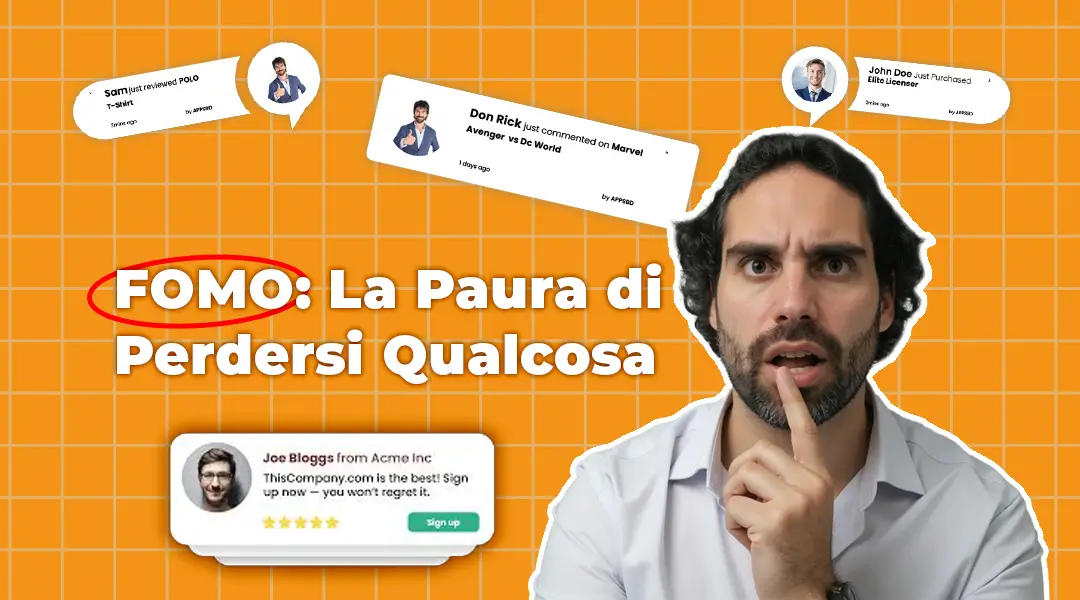
The Fear of Missing Out (FOMO) It is one of the most powerful psychological forces of our time. It is not merely the fear of missing out on an event or an offer, but a social and economic phenomenon that drives the decisions of millions of people every day.
👉 But Who is most vulnerable to FOMO?
👉 Does it vary depending on age and income?
👉 How do brands exploit (and sometimes manipulate) this fear to boost sales?
Let’s find out together by analyzing the phenomenon from every possible angle.
1. FOMO: Where It Comes From and Why It’s So Powerful
A Deep Psychological Mechanism
FOMO isn't just a fad or a social media phenomenon. It's a reaction deeply ingrained in our brains.
📌 The Neuroscience of FOMO: Studies show that the fear of missing out activates the same areas of the brain as physical pain. When we see others participating in something we weren’t invited to or buying a product that’s about to sell out, our brain interprets this situation as a social threat, prompting us to act quickly.
📌 The Role of Social Media: Digital platforms have amplified FOMO because they keep us constantly connected to other people’s experiences. 69% of Instagram users say they have purchased something just because he saw it on social media.
📌 FOMO and consumption: The fear of missing out is one of the key drivers of modern marketing. Limited editions, limited-time offers, exclusive invitations: Everything is designed to trigger our fear of being left out.
Differences Between Real FOMO and Marketing-Induced FOMO
Not all FOMO is the same. Some forms are spontaneous, while others are deliberately created by companies.
| Type of FOMO | Description | Example |
|---|---|---|
| Natural FOMO | It stems from an authentic social experience. | Not being invited to a party with friends. |
| Marketing-Induced FOMO | It is artificially created to boost sales. | “Only 10 left! Buy now!” |
| Experiential FOMO | Linked to unique and memorable experiences. | Exclusive trips, VIP concerts, and limited-attendance events. |
| Status FOMO | Based on the fear of not belonging to an elite group. | Luxury cars, designer handbags, Rolex watches. |
Now let's take a closer look How FOMO varies across different age groups e among low- and high-income consumers.
2. FOMO and Age Groups: Who Is Most Affected?
FOMO strikes all generations, but in very different ways.
Teens (ages 13–19): The FOMO of Social Belonging
Teenagers are the most vulnerable to FOMO because their primary need is to be accepted into the group. The fear of missing out is not so much related to the event itself as to the risk of being excluded from social conversation.
🧠 Factors that exacerbate FOMO in teenagers:
- Social media and popularity metrics (likes, views, shares).
- Stories and content that disappear after 24 hours, causing anxiety about loss.
- Fashion and Technology: Having the latest iPhone or the hottest sneakers is a status symbol.
Case Study: Limited-Edition Sneakers
Nike, Adidas, and Supreme have built their empires on teenage FOMO. The release of new sneakers in ultra-limited quantities generates endless lines in front of the stores and the crazy prices on the secondary market. Anyone who can’t get their hands on the model at launch feels excluded from the group.
Young Adults (Ages 20–35): FOMO Over Experiences and Status
As young adults become more financially independent, their FOMO shifts from material possessions to experiences.
🌍 The New Priorities of FOMO Among Millennials and Gen Z:
- Exclusive Travel and dream vacations.
- Music events and festivals (Coachella, Tomorrowland, Burning Man).
- Special-edition tech gadgets (iPhone, Tesla, NFT).
Case Study: The Coachella Festival
Coachella tickets are selling out months before the artists are even announced. The true value of the event isn't the music, but the’a chance to say, “I was there”. The audience buys not only a ticket, but also social status that results from it.
Middle-Aged Adults (Ages 36–64): The Invisible FOMO Between Work and Social Status
People over 35 experience FOMO in a less obvious way, but just as intensely. Here, the fear is no longer not belong to a group, but fall behind colleagues and competitors.
📊 How does FOMO manifest in adults?
- Work and Career: fear of missing out on a business opportunity or a promotion.
- Investments and Financial Trends: The rush toward cryptocurrencies, NFTs, and startups.
- Exclusivity and luxury: luxury cars, rare watches, exclusive events.
Case Study: Tesla and Cybertruck Pre-orders
When Tesla opened pre-orders for the Cybertruck, it only required a small deposit. The result? Over 1.9 million bookings in just a few days. The buyer didn't need the car, but she was afraid of missing out on a once-in-a-lifetime opportunity.
3. FOMO and Income Brackets: How Does It Vary Between Low- and High-Income Earners?
In addition to age, Income level plays a key role in the way FOMO is perceived and leveraged in marketing.
🔹 Low-income consumers experience a form of FOMO that is more closely tied to the fear of missing out on a chance to save money, acquire desired goods, or improve their social status.
🔹 High-income consumers experience a more subtle form of FOMO, based on’exclusivity and rarity. Here, the fear is not so much of being unable to access something, but of not belonging to a select circle of privileged individuals.
FOMO Among Low-Spenders: The Fear of Missing Out on a Once-in-a-Lifetime Opportunity
For those on a tight budget, FOMO is closely linked to perceived value and access to goods and services that might otherwise be out of reach.
Characteristics of FOMO Among Low-Income Consumers
💰 Accessibility FOMO
- The fear of missing out on a once-in-a-lifetime offer (e.g., “70% discount—today only!”).
- The rush for seasonal sales and flash sales.
- The fear of not being able to afford items perceived as “status symbols” (e.g., high-end smartphones, designer clothing).
🛍 FOMO and impulse buying
- 62% of low-income consumers report that they bought something on sale that they wouldn't have bought at full price, for fear of missing out.
- Black Friday and Cyber Monday are events during which this group of consumers is most susceptible to FOMO.
📱 Digital FOMO and Loyalty Programs
- Cashback apps and push notifications with personalized offers are among the most effective strategies.
- E-commerce platforms like Amazon and Shein capitalize on FOMO by Countdown timers and “Last items available” to encourage immediate conversion.
Case Study: Amazon and FOMO in Online Shopping
Amazon is a master at using FOMO to target budget-conscious shoppers. Strategies such as:
✅ Limited-time offers with a countdown (“Only for the next 3 hours!”).
✅ Perceived scarcity (“Only 2 left in stock!”).
✅ Popularity notifications (“50 people are viewing this product right now!”).
All of these factors lead consumers to feel like you're competing with other buyers, creating an urgent need to buy right away.
FOMO Among High Spendors: The Fear of Not Belonging to the Elite
People with high purchasing power are not immune to FOMO, but they experience it very differently.
Characteristics of FOMO Among High-Income Consumers
🎩 Fear of missing out on exclusivity
- The desire to own unique, niche items.
- The importance of’privileged access (invitations to private events, private collections).
- The concept of “scarcity premium”, where high prices and limited availability increase perceived value.
🔑 FOMO and Experiential Luxury
- The fear of not have unique experiences such as dinners with Michelin-starred chefs, trips to exclusive destinations, and private auctions.
- The fear of losing a spot on the VIP list major events (e.g., Art Basel, Monaco Yacht Show).
💎 The Collecting Factor
- Limited editions of cars, watches, luxury handbags, and works of art.
- The belief that a purchase can become a collector's item.
Case Study: Hermès Birkin and Artificial FOMO
Hermès has created one of the biggest FOMO phenomena in the luxury industry: the handbag Birkin.
🔹 Waiting lists that last for years – Even though they could produce more models, Hermès keeps its selection limited to create a sense of desire.
🔹 Access for selected customers only – Money isn't enough; you have to be in the right circle.
🔹 Secondary market value – The price of Birkin bags continues to rise, making even more people want one.
The result? One of the most successful FOMO strategies in the history of luxury marketing.
Comparison Table: FOMO Among Low- and High-Spenders
| Appearance | Low Spender | High Spender |
|---|---|---|
| FOMO triggers | Discounted prices, limited-time offers, your last chance to save. | Exclusivity, limited access, private events. |
| Main reason | Maximize the economic value of the purchase. | To secure social status and a position among the elite. |
| Types of purchases | Discount electronics, fast fashion, consumer goods. | Luxury cars, collectible watches, art, and investment assets. |
| Effective marketing strategies | Flash sales, installment payments, digital coupons. | Waiting lists, VIP invitations, limited editions. |
| Example of a brand | Amazon, Shein, McDonald’s (with limited-time offers). | Hermès, Ferrari, Rolex (in extremely limited supply). |
4. How Marketing Exploits FOMO: Winning Strategies and Manipulation
FOMO isn't just a natural phenomenon, but a strategic tool used by brands to encourage purchases. Some companies do this ethically, while others use more manipulative tactics.
Marketing Strategies Based on FOMO
📢 Strategy #1: Artificial Scarcity
- Create a limited-edition product, even if production volumes might be higher.
- Ex. Rolex It produces fewer watches than the market demands in order to maintain a sense of exclusivity.
⏳ Strategy #2: Time-Sensitive
- Limited-time offers or limited availability.
- Ex. Booking.com Use messages like “Only 2 rooms left” to encourage immediate bookings.
🔐 Strategy #3: Exclusivity and Restricted Access
- Events and products available only to select members.
- Ex. American Express Centurion Card, an exclusive credit card available by invitation only.
🛍 Strategy #4: Social Proof Effect
- Show how many others are buying to create a sense of urgency.
- Ex. Zalando It says, “10 people have bought this item in the last 24 hours,” to encourage a purchase.
5. The Economic and Psychological Implications of FOMO
We have seen how the Fear of Missing Out influences purchasing behavior and how marketing leverages this to encourage people to buy. But What are the actual effects of FOMO on the economy and consumer psychology?
This section examines two key aspects:
1️⃣ The economic impact the impact of FOMO on the market and spending habits.
2️⃣ The psychological implications for consumers, ranging from anxiety and financial stress to shopping addiction.
5.1 FOMO and the Economy: How Much Does the Fear of Missing Out Cost Us?
FOMO is a powerful economic driver, capable of pushing people to spend more than they normally would.
📊 Key facts about the economic impact of FOMO:
- The 60% of Millennials has made at least one impulse purchase in the past 12 months due to FOMO.
- The 40%: People are spending more than expected during events such as Black Friday, Prime Day, or seasonal sales.
- Companies that use FOMO strategies increase the conversion rate by up to 300% compared to traditional strategies.
- The luxury market uses FOMO to create increases in value of 200–500% on exclusive products.
Sectors Most Affected by FOMO
| Sector | How FOMO works | Examples of leading companies |
|---|---|---|
| Fashion and Luxury | Limited editions, waiting lists, exclusive collaborations. | Supreme, Hermès, Rolex. |
| Technology | Pre-orders, limited quantities, exclusive launch events. | Apple, Tesla, Sony (PS5). |
| E-commerce | Limited-time offers, low-stock alerts, flash sales. | Amazon, Shein, Zalando. |
| Travel and Experiences | Last-minute reservations, exclusive events, VIP packages. | Airbnb, Booking.com, Coachella. |
| Cryptocurrencies and NFTs | Hype, fear of missing out on the opportunity of a lifetime, virality. | Bitcoin, Ethereum, and NFTs like Bored Apes. |
📉 The flip side of the coin: when FOMO leads to financial problems
FOMO doesn't just benefit the market; it also an increase in personal debt.
- The 34% of people under 35 have incurred debt from purchases driven by FOMO.
- The 201 out of 300 people said they had spent money they couldn't afford for fear of missing out on an opportunity.
- The 45% of social media users admit to feeling pressure to keep up with the purchases of their friends or the influencers they follow online.
Case Study: The Cryptocurrency Boom and the Financial FOMO Disaster
In 2021, the surge in the value of Bitcoin and Ethereum created a rush to make impulsive investments. Many inexperienced investors, driven by the fear of missing out on the “opportunity of a lifetime,” bought at all-time highs, only to lose thousands of dollars when the market crashed.
5.2 Psychological Implications: When FOMO Becomes Toxic
📌 Anxiety and stress caused by social comparison
A study found that people with high levels of FOMO:
- They sleep worse because of the constant fear of falling behind.
- They have higher stress levels because they always feel under pressure.
- They are less satisfied with their purchases, because they focus more on what they don't have than on what they do have.
📌 Addiction to shopping and instant gratification
The mechanism behind FOMO is similar to that of a addiction: Every purchase driven by the fear of missing out triggers dopamine, the "pleasure" neurotransmitter.
👉 But the pleasure is short-lived, leading to a constant need for new purchases in order to experience the same level of satisfaction.
📌 The impact of notifications and social media algorithms
Social media platforms use notifications specifically designed to keep users in a constant state of FOMO.
- If TikTok sends you a message like “Someone you follow just posted a video!”, it’s to make you worry that you’re missing out on something.
- If Instagram shows “Your stories are about to expire,” it’s playing on the fear of time running out.
Case Study: FOMO Addiction on Instagram and TikTok
A study of 5,000 young people between the ages of 18 and 30 showed that the 58% Anxiety Test when she can't check social media for more than a day.
The reason? The fear of missing out on important updates and to feel left out of the constant stream of content.
6. How to Use FOMO Ethically in Marketing
We've seen how FOMO can be powerful, but also dangerous. Companies should use it responsibly, without manipulating consumers or causing them unnecessary anxiety.
Principles of Ethical FOMO Marketing
✅ Creating real value, not just a false sense of urgency
A positive example: Apple offers products with genuine innovative value, not just artificial limitations.
Negative example: Some fast-fashion brands create FOMO with “limited-time offers” that are constantly repeated.
✅ Don't use FOMO to push people into debt
A positive example: Loyalty programs that offer real benefits without encouraging unnecessary spending.
Negative example: Services Buy now, pay later that encourage young people to spend beyond their means.
✅ Give customers a sense of sustainable exclusivity
Positive example: Events reserved for the most loyal customers.
Negative example: Artificial waiting lists that waste consumers' time.
7. Conclusions: FOMO Is a Powerful Tool, But It Must Be Used Wisely
The Fear of Missing Out It is a powerful tool in modern marketing. When used effectively, it can boost engagement, generate buzz, and help a brand grow.
But if it is exploited excessively or manipulatively, it can have negative effects on consumers' mental and financial health.
👉 If you're a entrepreneur, you have to ask yourself: Am I creating an experience that’s truly worth not missing out on, or am I just creating unnecessary anxiety for my clients?
👉 If you're a consumer, before giving in to FOMO, ask yourself: Am I buying this because I need it, or just because I'm afraid of missing out?
BUT THAT'S NOT ALL—GET THE EBOOK "FOMO IN DIGITAL MARKETING" NOW
Over 40 pages packed with useful and practical tips to apply to your website or e-commerce site (and more)