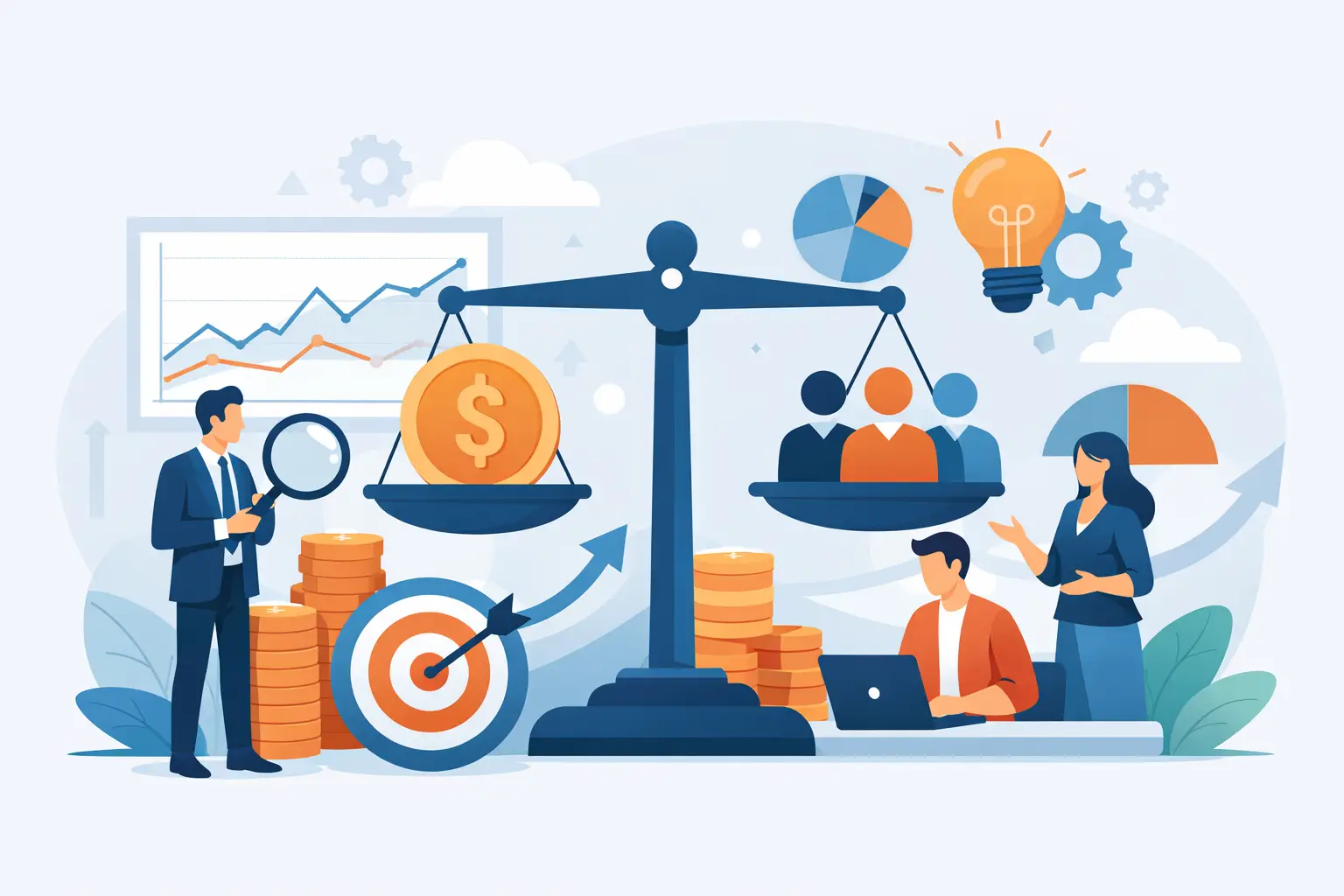
A 20-euro lead can be a great deal or a disaster. It depends on how much revenue it generates, how much profit margin it leaves, how long it takes for the prospect to make a purchase, and how many resources are needed to turn it into a customer. That’s why searching online for a Customer Acquisition Cost Benchmark Failing to take your business model into account often leads to just one thing: cutting campaigns that were working or keeping channels active that are burning through cash.
CAC, or Customer Acquisition Cost, isn't a metric you include in a report just to look good. It's the number that tells you how much you're paying to add a customer to your business. If you don't know it, you're not doing marketing—you're just making paid attempts.
Customer Acquisition Cost Benchmark: Why There Is No Magic Number
Those who sell B2B consulting services, equipment, professional services, or software cannot use the same benchmark as an e-commerce business that sells products for 30 euros. A local business that acquires a patient or a repeat customer can afford a higher CAC than one that sells a one-time, low-margin service.
The benchmark is useful for determining whether you're out of line with the market, not for deciding exactly how much you should spend down to the cent. The correct figure is derived by cross-referencing four variables: average order value, gross margin, repurchase frequency, and sales conversion rate.
Let’s look at two simple examples. A professional who sells a consulting service for 300 euros with a 250-euro margin cannot sustain a CAC of 200 euros over the long term, unless that client goes on to purchase other services. A software company that sells a subscription for 500 euros per month and retains the customer for two years, on the other hand, can invest 800 or 1,000 euros to acquire that customer, provided the margin and retention rate justify it.
The point isn't to pay a low price. The point is to pay less than what that customer generates over time.
How to Calculate the CAC Without Pulling the Wool Over Your Eyes
The basic formula is straightforward:
CAC = total acquisition costs / number of new customers acquired
The problem is that many companies include only advertising spend in the numerator. This gives them a reassuring—but false—figure. If you spend 2,000 euros on Meta Ads and acquire 10 customers, the advertising cost per customer is 200 euros. But if you also paid a freelancer, a sales representative, software, creative work, and internal staff hours to generate and manage those sales, the actual CAC is higher.
For a thorough analysis, your acquisition costs should include advertising budgets, management fees, landing page and content production, CRM tools, automation, sales team costs, and promotional activities directly related to sales. There’s no need to attribute every office expense to marketing. You need to stop pretending that marketing is free as soon as you step away from the advertising platform.
Use a consistent time frame. If your sales take 60 or 90 days to close, comparing January’s spending to contracts signed in the same month skews the results. It’s better to measure by cohort: analyze the leads acquired in a given month and track how many of them become customers in the following months.
CAC by channel: Aggregated data can mask inefficiencies
An average CAC of 250 euros may seem acceptable. But it could include Google Ads that acquire customers at 120 euros, Meta Ads at 350 euros, and referrals at 40 euros. If you only look at the total, you won’t understand where to increase your investment, what to adjust, and what to pause.
Separating channels is essential, but it’s not enough. You also need to distinguish between cost per lead, cost per scheduled appointment, cost per qualified opportunity, and final CAC. A channel can generate low-cost leads and very expensive customers because it attracts people who are merely curious, off-target, or without a budget. A lead isn’t the finish line. It’s just the beginning of the cost.
Market benchmarks to be used with caution
In Italy, for local businesses and professionals, the cost per lead can range from a few dozen to over 100 euros, depending on the industry, geographic area, and value of the offering. In highly complex B2B services, a qualified lead can cost much more and still be perfectly sustainable. For e-commerce and low-ticket products, however, the CAC must be much lower, unless there is a strong pattern of repeat purchases.
There are sectors where advertising competition drives costs up: finance, law, insurance, education, private healthcare, real estate, and business services. In these sectors, comparing yourself to a generic benchmark is even less useful. What matters is the quality of the demand you capture, not the national average found in a table without context.
A more reliable indicator is the ratio of CAC to customer value over time, often referred to as LTV. If a customer generates a profit of 3,000 euros over their lifetime and the CAC is 300 euros, you have a healthy ratio. If you spend 1,500 euros to acquire that customer, the model can still work, but it requires liquidity, high retention, and a controlled sales process. If you collect payment after six months but pay for advertising today, the problem isn’t just about ROI—it’s about cash flow.
The right threshold depends on the margin, not on ego
Many entrepreneurs want to lower their CAC on principle. This is understandable, but it can become a hindrance. If a channel brings in profitable and scalable customers, shutting it down simply because the customer acquisition cost has risen by 15% could mean leaving revenue on the table for competitors.
CAC should be monitored, not idolized. A higher CAC may be acceptable if it increases the average order value, improves customer quality, or reduces the churn rate. Conversely, a low CAC isn’t automatically a win if the customer makes only one purchase, requires endless support, and doesn’t generate profit.
To determine an operational threshold, start with the gross margin from the first sale. Decide how much you’re willing to invest to acquire the customer without straining your cash flow. Then assess how much additional value the customer can generate over the next 6, 12, or 24 months. This is the difference between buying revenue and building growth.
When your CAC grows, don't just cut everything indiscriminately
A rising CAC doesn't automatically mean you should stop your campaigns. First, you need to figure out where the funnel broke down. There are four common causes:
- Traffic costs have risen because the market is more competitive;
- The campaign is reaching a less relevant audience than before;
- landing pages, offers, or messages have lower conversion rates;
- Leads are coming in, but the sales team is slow to respond or handles the requests poorly.
This last point is overlooked far too often. You may have effective ads and an excellent landing page, but if a prospect doesn’t receive a response for eight hours, they’ve likely spoken with someone else in the meantime. Your CAC goes up because you’re paying for leads that your sales process lets go cold.
Here CRM, Automation, and Follow-ups They aren't technical tools. They're cost-effective levers. An immediate response, a recovery sequence, and an updated pipeline can increase the number of closed deals without raising the ad budget by a single euro. In practice, they lower the CAC by improving conversion rates, not by reducing the cost per click.
The customer acquisition cost benchmark should be analyzed in conjunction with the funnel
If you want to know whether your CAC is healthy, take a look at the full funnel. How many people see the ad? How many provide their contact information? How many schedule a call? How many show up? How many receive a quote? How many sign up? Each step reveals a part of the problem.
When traffic is expensive but conversion rates are high, you can focus on improving average efficiency and expanding your channels. When traffic is inexpensive but deals aren't closing, the priority is to better qualify leads and improve the sales process. When everything is running smoothly but you're struggling to manage your contacts, you need an operational structure that ensures marketing supports sales—not two departments that pass the buck to each other.
WebWakeUp focuses precisely on this continuity: campaigns, pages, CRM, and automations must all work together. Because buying traffic without a system to turn it into opportunities is like filling a bucket with a hole in it and wondering why the water level doesn't rise.
The number to track each month
Don’t look for a benchmark just to put your mind at ease. Build your own internal benchmark, month by month, by channel and by customer type. If your CAC is rising while your margin, close rate, and lifetime value are improving, you may be making a sound investment. If it rises while sales slow down and follow-up remains manual, you’re funding inefficiencies.
You don’t optimize your customer acquisition cost with a more colorful dashboard. You optimize it when every euro follows a clear path: ad, lead, response, proposal, sale, repeat purchase. That’s when your budget stops being an expense and starts working toward your revenue.