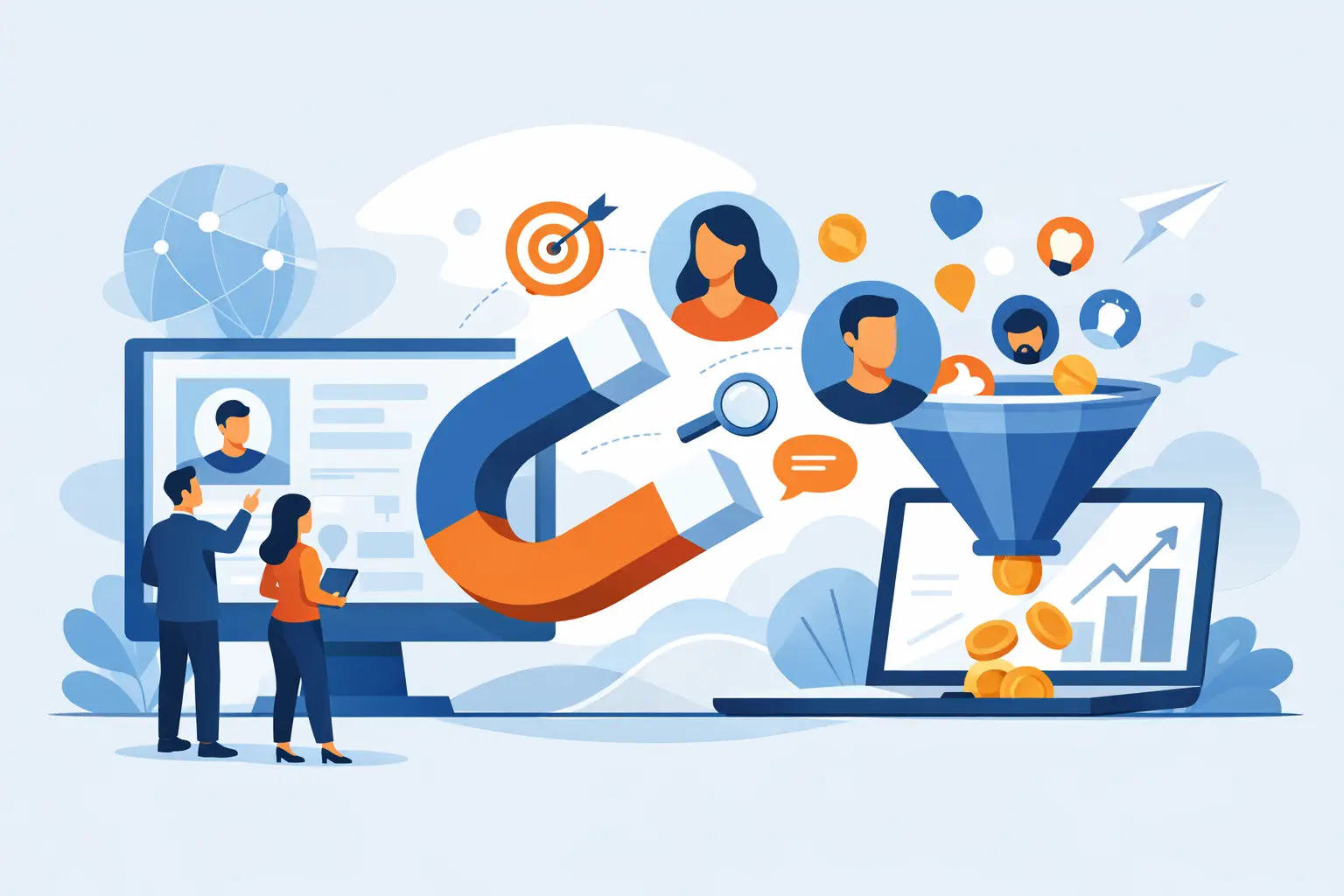
The problem isn’t having a website. The problem is that often the website doesn’t generate leads, campaigns don’t convert, and leads get lost between WhatsApp, email, and phone calls. If you’re wondering how to acquire customers online, the answer isn’t a trick or a random sponsored post. You need a system that turns attention into appointments and appointments into revenue.
Many companies start off on the wrong foot. They invest in graphic design, a redesigned logo, and some social media content, and then they’re surprised when the results don’t materialize. Online, it’s not the most visually appealing business that wins. The winner is the one who gets found, makes a compelling case in just a few seconds, and effectively manages the sales process from the first click all the way to closing the deal.
How to Acquire Customers Online Without Wasting Your Budget
The first truth is simple: traffic alone isn’t enough. You can drive a thousand people to your site, but if your offer is unclear, the page is slow, the form is useless, or no one follows up with leads quickly, you’re just paying for visits. And visits don’t pay the bills.
To effectively acquire customers online, you need four elements working together. The first is visibility, which includes SEO, Google Ads, Meta Ads, or other channels suited to your market. The second is conversion, meaning pages designed to prompt a specific action. The third is lead management, using CRM, automation, and follow-ups. The fourth is continuous optimization, because what works today may need to be adjusted in three months’ time.
When even just one of these pieces is missing, the cost goes up. And you usually don't notice it right away. You realize it later, when you've spent the money and have little to show for it.
The starting point: clear supply and real demand
Before we talk about tools, there’s one thing we need to make clear that many people avoid addressing: if your offering is generic, your marketing will struggle. It’s not enough to say “we focus on quality” or “we’ve been professionals for years.” Everyone says that.
People searching online want to quickly understand three things: what you do, who you do it for, and why they should choose you over a competitor. The vaguer the message, the more traffic you lose. The more specific it is, the more relevant inquiries you’ll receive.
A lawyer who talks about “legal advice” gets lost in the background noise. A lawyer who discusses debt collection for small businesses or quick-track divorces is engaging in a concrete conversation. The same applies to medical practices, B2B companies, specialized artisans, and local businesses.
There’s also a trade-off here: being more specific may seem limiting, but it’s often the opposite. It attracts fewer casual browsers and more potential customers.
The right channels for acquiring customers online
There’s no one-size-fits-all solution. There is, however, a channel that’s best suited to your business, your profit margin, and the timeframe in which you want to see results.
Google Ads captures existing demand
If you sell a service that people look for when they have a specific need, Google Ads is often the fastest route. Searchers already have a specific goal in mind. They’re comparing options—they’re not wasting time. This is especially true for professionals, local businesses, technical services, private healthcare, consulting, and many B2B businesses.
The downside is that demand comes at a cost. If the industry is competitive, clicks can be very expensive. That’s why a well-executed campaign isn’t judged by cost per click, but by cost per customer acquired.
Meta Ads drives demand and speeds up the decision-making process
Facebook and Instagram work well when you need to explain an offer, generate interest, or retarget people who already know you. They’re also useful when your audience isn’t actively looking for your service every day, but can be persuaded if they see the right message.
There’s only one risk here: promoting weak content to weak pages. The result is always the same: lots of visibility, but few useful leads.
SEO works best over the medium term
If you want to reduce your reliance on advertising over time, SEO remains a key tool. But let’s be clear: it’s not a shortcut for those who don’t want to invest. It’s an asset that requires structure, consistent content, well-built pages, and consistency.
For many small and medium-sized businesses, the best approach isn’t to choose between SEO and advertising. It’s to use advertising to generate results in the short term and SEO to build a more stable, long-term flow of traffic.
The website doesn't have to be liked. It has to convert.
This is where many companies shoot themselves in the foot. They commission a showcase website and then expect it to generate leads like a sales machine. It doesn’t work that way.
A website that attracts customers online has a clear structure. It immediately makes it clear what you’re offering, presents credible evidence, addresses objections, and guides the user toward a call to action, a quote request, or direct contact. Every element must serve a purpose. If a section doesn’t help convince visitors or prompt them to take action, it’s just dead weight.
Also Speed matters. If the page loads slowly, is hard to read on mobile, or if the form feels like an interrogation, you’re losing conversions before you even have a chance to measure them.
In many cases, a landing page works better than a website full of menus and distractions. It depends on the type of campaign and the audience’s level of awareness. People who arrive from an ad often need a direct path, not to have to navigate through ten pages.
Without follow-up, you're handing leads to your competitors
This is the most overlooked point of all. Many people talk about traffic and campaigns, but then they just leave their leads in an email inbox that they check only occasionally. It’s a costly mistake.
Leads must be handled immediately. If someone fills out a form today and receives a response tomorrow, they will have already contacted three other companies in the meantime. Whoever follows up first has the advantage. Automating confirmations, reminders, and sales assignments helps reduce lead loss. Who uses a CRM sees what's really going on and stops relying on rote memorization.
Acquiring customers online isn’t just about generating leads. It’s about building a process where no opportunity goes to waste. This is where automation, chatbots, and workflows make a difference: they don’t replace the sales process, but they prevent operational gaps that cost you money.
Measuring Accurately: The Numbers That Really Matter
Many companies are satisfied with superficial metrics. Impressions, clicks, reach, likes. These can be useful, but they aren’t enough to manage an investment.
If you want to know whether the system is working, you need to look at other metrics: cost per lead, page conversion rate, average response time, appointment booking rate, closing rate, and average customer value. Only then can you tell whether a campaign is actually bringing in business or just generating traffic.
Sometimes the problem isn't marketing but sales. Other times, it's the other way around. Without tracking, you're just guessing. With data, you can make adjustments.
How to Acquire Customers Online in a Sustainable Way
The temptation to go for the quick fix is strong. A cheap freelancer, a campaign launched in a hurry, a website built once and left untouched for years. It seems like a cost-saving measure. Often, it’s just delays disguised as convenience.
A sustainable system is one that you can maintain, measure, and improve over time. It doesn’t necessarily require a huge budget, but it does require consistency. The digital world rewards those who stay engaged with the process, not those who make a one-off effort and then disappear.
That’s why it makes more and more sense today to think not in terms of individual projects, but as a continuous process. Websites, advertising, CRM, automation, and optimization are not separate components. They are part of the same engine. When managed as silos, losses multiply. When managed together, the cost of acquisition tends to decrease and the quality of leads increases.
WebWakeUp was founded precisely on this principle: not as a provider that simply delivers and walks away, but as an external technical and marketing team that remains active as the business evolves.
If you want more online customers, stop wondering which tool to use first and start looking at the bigger picture. The market doesn’t reward those who are simply present online. It rewards those who have a system that works every day, even when you’re doing something else.