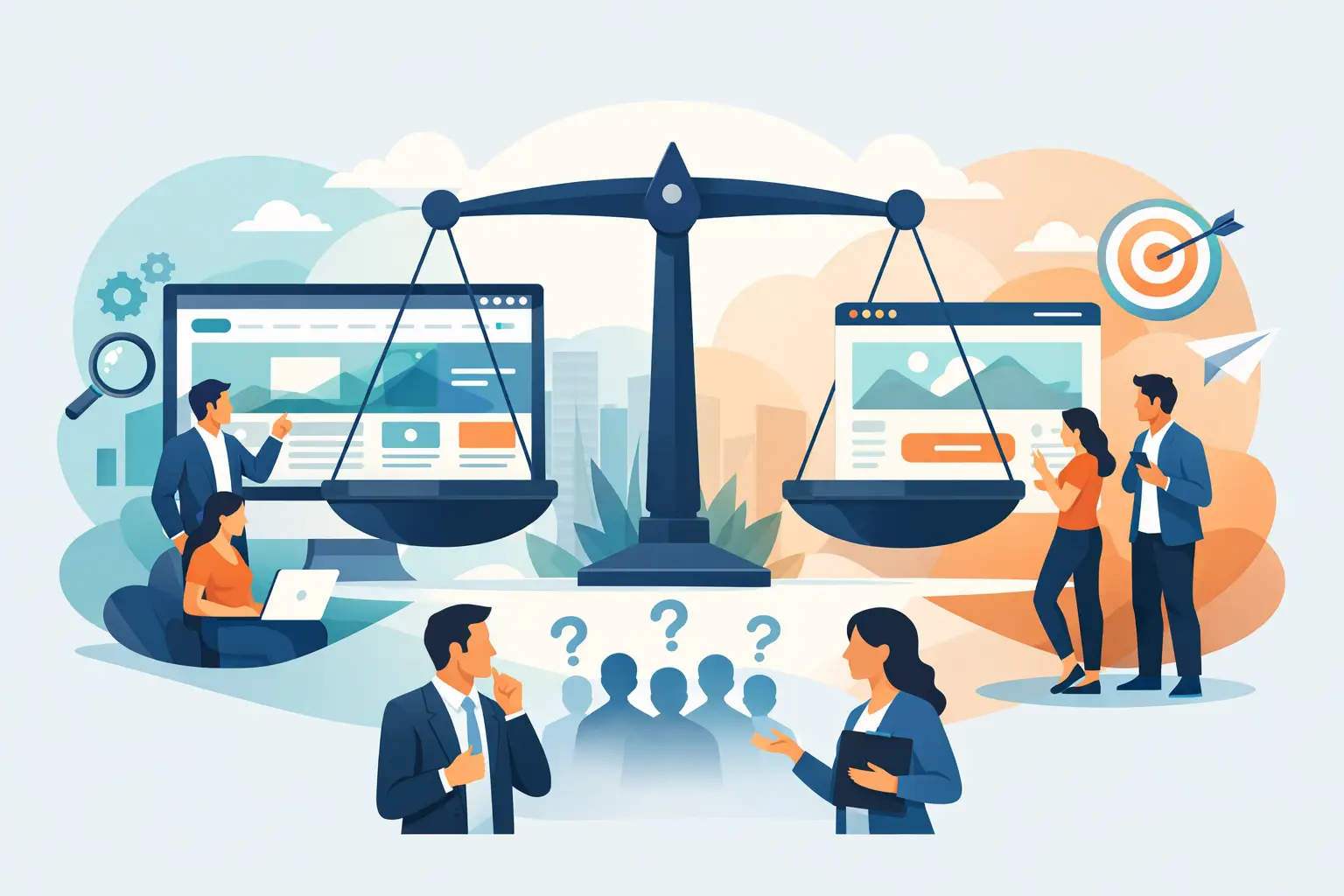
An entrepreneur invests in campaigns, drives people to their digital space, and then waits for inquiries. But if they send that traffic to a confusing page—with ten services, three menus, and no clear direction—they’re paying to drive potential customers away. The question of whether to use a website or a landing page isn’t about design—it’s about where to allocate your budget to drive concrete action.
A website can build trust, visibility, and credibility. A landing page can turn a click into a lead. Choosing the wrong tool isn’t just a technical detail—it means increasing the cost per lead, slowing down sales, and ceding ground to competitors who have a simpler path.
Website or Landing Page: The Difference That Matters
A website is a company’s digital home. It tells visitors who you are, what you do, who you work for, what services you offer, and why a customer should trust you. It has multiple pages, a well-structured navigation system, and plays a key role in organic visibility on Google. It’s the right tool when someone needs to learn more before contacting you.
A landing page, on the other hand, is a page designed for a single purpose. It might be to request a quote, book a consultation, download a guide, register for an event, or request a demo. It doesn’t offer ten different options—it offers just one and guides the user all the way to conversion.
The difference is simple. On your website, you say, “Here’s our company.” On a landing page, you say, “Do you have this problem? Here’s what you’ll get, why you should act now, and what to do to get started.”.
Those who treat a landing page as if it were a full-fledged website end up creating a bland and unconvincing page. Those who direct an ad campaign to a website’s homepage, on the other hand, often pay for clicks that get lost among menus, generic sections, and trivia with no commercial value. The point isn’t to declare an absolute winner. The point is to assign each asset the specific role it’s meant to fulfill.
When You Need a Website
A website is essential when your business needs to be found, verified, and understood. For many small and medium-sized businesses, local businesses, and professionals, it’s the bare minimum required to avoid appearing unprofessional to those searching for information online.
Whether you run a professional practice, a construction company, a medical center, a B2B business, or a multi-service business, people don’t always make a decision after just one click. They want to see case studies, areas of expertise, geographic coverage, reviews, how you work, and clear references. A well-designed website answers these questions without forcing you to repeat them during every call.
It also helps monitor searches with commercial intent. Anyone searching for “accountant in Milan for an SRL,” “condominium facade renovation,” or “technical service management software” is already expressing a need. If you don’t show up in the search results—or if you do but your website is slow, outdated, and hard to understand—the customer won’t wait for you to fix it: they’ll click on a competitor.
But be careful: a website doesn’t generate results just because it’s online. A static showcase website that’s never updated and lacks calls to action is a cost disguised as an investment. Your digital presence must evolve alongside your offerings, campaigns, seasonal trends, and business goals.
This website is the right choice if you need to
Do you need to showcase more services or products, want to work on SEO, need to build your reputation and trust, or are you reaching users at very different stages of the buying journey? It’s also essential when the sales cycle is long and the decision-making process requires comparison.
In these cases, however, the website must have pages designed to drive conversions. It’s not enough to simply add a contact form to the footer and hope for the best. Every strategic service page must explain the problem, the solution, the benefits, the evidence, and the next steps.
When a Landing Page Generates More Revenue
A landing page is essential when you're running ads or promoting a specific offer. If you're investing in Google Ads, Meta Ads, or TikTok Ads, you must ensure strict consistency between your ad and your landing page.
Have you posted an ad offering a free consultation on reducing energy costs? Users should be directed to a page dedicated to that consultation, not to the homepage with the company history, list of services, and blog. Every second of friction reduces the likelihood of a lead.
An effective landing page highlights a recognizable problem, a concrete and credible promise, the benefits of the offer, supporting evidence, and a visible call to action. It doesn’t necessarily have to be short. It must eliminate doubts before they lead to abandonment.
For example, a company that sells solar power systems can use a landing page for a preliminary assessment. A B2B consultant can offer an audit. A gym can promote a trial session. A software company can collect requests for demos. In all these cases, the page shouldn’t tell the whole story—it should prompt visitors to take the right next step.
A landing page can't save a weak offer
Here’s the part that many people prefer to ignore. A landing page doesn’t automatically turn cold traffic into customers if the offer is generic, the positioning is unclear, or no one responds to leads promptly.
You can have persuasive copy, a clean design, and a flawless form. But if you ask a potential customer to leave their phone number without telling them what they’ll get in return—or if you follow up with them two days later—you’re squandering opportunities. The page is just one link in the chain.
To achieve results, you need tracking, contact management, follow-up, and a sales team that knows how to take action. Otherwise, the problem isn't the website or landing page—it's that you're generating leads without a process to turn them into revenue.
The choice depends on the source of the traffic
The most useful question isn’t “What’s cheaper?” but “Where do people come from, and what do they need to do?” Organic traffic from Google can land on website pages optimized for specific searches. Traffic from a paid campaign should almost always land on a dedicated landing page. Someone searching for you after receiving a referral might want to visit your site to find out who you are before calling you.
The audience’s level of familiarity also makes all the difference. A user who doesn’t know you needs more context, evidence, and clarity. A prospect who has already seen one of your presentations may convert on a more straightforward page. Copying the same structure for every audience is a shortcut that costs you money.
Another common mistake is creating a single landing page and using it for every campaign. The offer for someone looking for an urgent solution cannot be the same as the one for someone who is just evaluating their options. The objections change, the selling points change, and the call to action changes.
The Model That Works: Website, Landing Page, and Automations
Companies that grow consistently don’t choose between a website and a landing page as if they were mutually exclusive alternatives. They build an ecosystem where the website establishes credibility and captures demand, landing pages convert campaigns into leads, and automation ensures that leads don’t get stuck in an email inbox.
Imagine this process: a person sees an ad, lands on a dedicated landing page, submits their information to request a consultation, and immediately receives a confirmation. The lead is added to the CRM, the sales rep receives a notification, an automatic reminder is triggered, and every step is tracked. At that point, you can see how much you’re paying per lead, how many leads turn into appointments, and which campaigns actually drive sales.
This is the difference between simply having an online presence and having a business machine. WebWakeUp operates precisely on this principle: not just delivering a webpage and disappearing, but maintaining an active system that can be adjusted, tested, and improved month after month.
How to Make Decisions Without Wasting Your Budget
If you’re starting from scratch, your website remains the top priority when it comes to building your reputation, showcasing your services, and making sure people can find you. But don’t put off creating the pages dedicated to the products and services you actually sell indefinitely. A well-designed service page can already have a conversion-oriented structure and serve as the foundation for future campaigns.
If you already have a website but traffic is low, don't jump right into a complete redesign. Check first where you lose people: Is traffic too low, is the proposal unclear, are the calls to action weak, or is the form too long? Often, a targeted landing page and a well-planned campaign teach us much more than months spent discussing colors and animations.
If You're already investing in advertising, stop sending everyone to the homepage. Create a page for each strategic offer, set up tracking, and measure the quality of the leads—not just their quantity. A hundred useless inquiries aren't worth ten appointments with people who are genuinely interested.
The best decision isn’t the one that saves you money today. It’s the one that makes every euro you invest more manageable and brings every lead closer to a sale. Your digital strategy needs to do one very specific thing: guide the right people to take the next step, without leaving them at the mercy of menus, wait times, and vague promises.