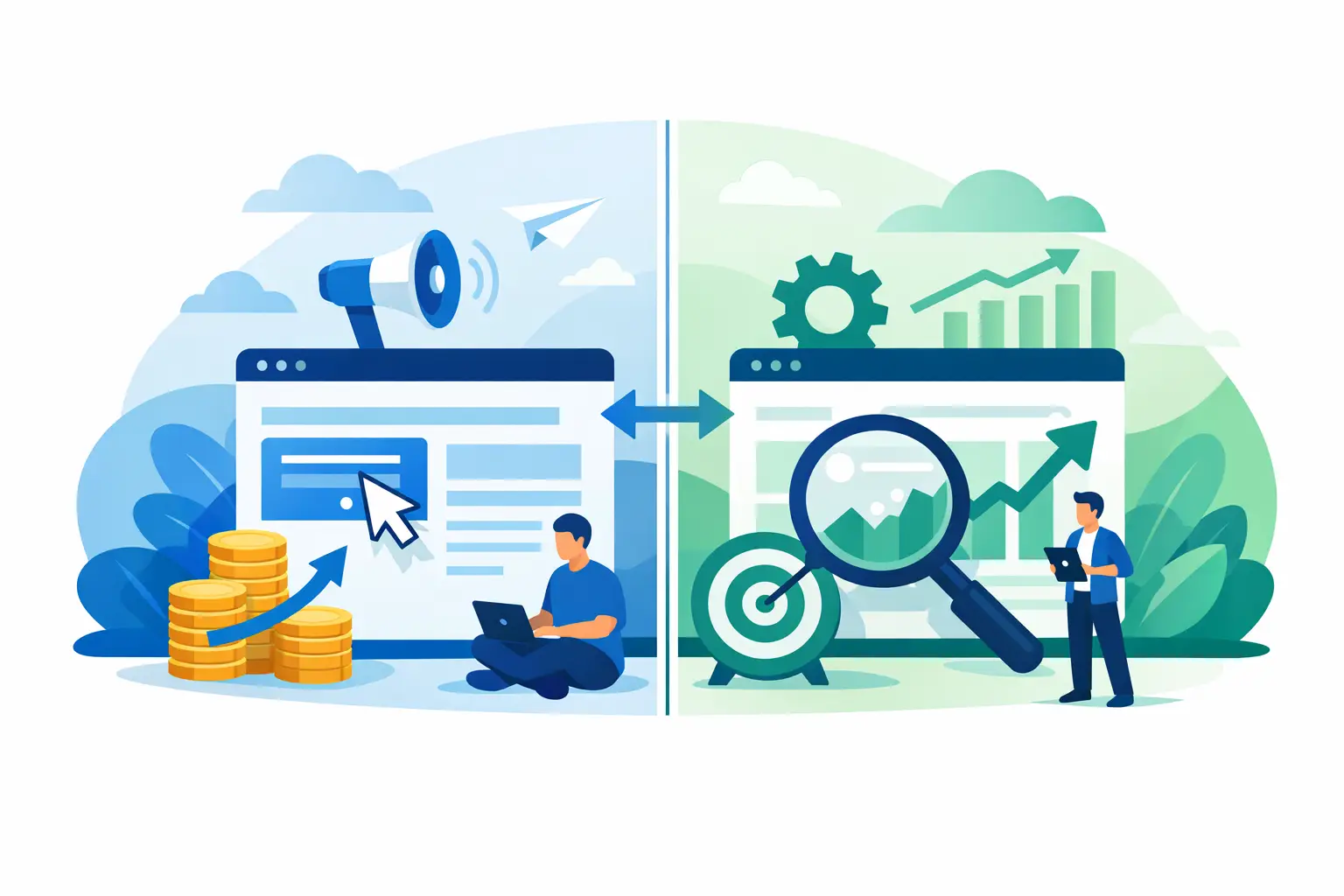
A website that gets no traffic and a campaign that generates leads that are too expensive lead to the same result: the sales rep is left without opportunities. The choice between Google Ads or SEO This isn't a discussion for marketers. It's a decision about revenue, margins, and how quickly you want to stop losing customers to your competitors.
Many companies are looking for a simple answer: Is paid advertising better, or is SEO better? The honest answer is that it depends on where the business stands. But one thing is certain: choosing a channel without considering demand, supply, margins, the website, and the sales process is the quickest way to blow through your budget.
Google Ads or SEO: The Difference That Really Matters
Google Ads captures attention right when someone is already looking for a solution. Launch a campaign, target relevant search queries, and you can generate qualified traffic in as little as a few days. You pay per click, so when you stop spending, your ads stop appearing.
SEO builds organic visibility. You work on your site’s structure, service pages, content, authority, and technical aspects to achieve rankings in organic search results. You don’t pay per click; instead, you pay for the work required to earn that ranking and maintain it over time.
To put it bluntly: Google Ads is a catalyst; SEO is an asset. The former can drive leads immediately, but it requires a budget and ongoing monitoring. The latter can lower the cost of acquisition in the medium term, but it’s not a magic wand that will fill your calendar next month.
The classic mistake is to treat them as two opposing teams. In reality, they have different goals and time horizons. The problem isn’t choosing an absolute winner. The problem is figuring out which lever to pull right now and what infrastructure you need to build so you don’t remain dependent on advertising forever.
When Google Ads Makes the Most Sense
Google Ads is the most logical choice when a business needs to generate demand in the short term and has a clear offering. A plumber who handles emergency calls, a clinic promoting a popular treatment, a B2B company offering a high-value service, or a professional with open slots in their schedule can reach people who are already searching.
It works especially well if you know the monetary value of a lead. If a new customer is worth a 2,000 euro profit margin and you close one out of every four deals, you can estimate how much you can spend to generate a lead. Without this data, your ad budget becomes an emotional gamble: one day it seems too high, the next too low, with no connection to the actual return on investment.
Ads are also useful for validating an offer. Before investing months in producing SEO content, you can test which services people are searching for, which messages generate leads, and which keywords attract only casual browsers. If interpreted correctly, campaign data can help you avoid building pages based on incorrect assumptions.
There is, however, one non-negotiable condition: don’t send paid traffic to a generic, slow page or one without a concrete offer. Buying clicks that land on a home page that says “quality and professionalism” is a fancy way of giving money away to Google. A landing page It must immediately answer the questions: What are you offering? Who is it for? Why should they choose you? And what should they do next?.
When SEO Is the Smartest Investment
SEO is recommended when there is demand, people are searching consistently, and the company can afford to wait the time needed to build its online presence. It is often a very powerful tool for local businesses, professionals, e-commerce sites with specific product categories, and B2B companies that sell solutions people search for online before making a sales call.
It doesn’t mean publishing an article every now and then. It means creating pages that capture real search intent: services, geographic area, problems, comparisons, costs, and alternatives. If you sell solar power systems, for example, a well-crafted page on installation, quotes, and the areas you serve is worth more than ten generic articles on energy savings.
The advantage is that a well-ranked page continues to generate traffic and inquiries even when you’re not paying for clicks. The limitation is just as clear: it depends on the competition, the quality of the site, the domain’s reputation, and the ability to offer content that’s better than what’s already out there. In competitive industries, promising the top spot in just a few weeks isn’t marketing—it’s a promise you should be wary of.
SEO isn’t free. It requires analysis, development, copywriting, technical optimization, and monitoring. But if you’re spending thousands of euros every month to appear in search results that you could eventually rank for organically, giving up on SEO means accepting a higher customer acquisition cost by choice.
The Misleading Comparison: Cost Per Click vs. Cost of Content
Comparing Google Ads and SEO solely based on the initial cost is misleading. Ads immediately shows a number: the cost per click, the cost per lead, the monthly budget. SEO seems more nuanced because results come gradually. But the useful question is a different one: how much does it cost to acquire a customer after six, twelve, or twenty-four months?
An ad campaign may have a seemingly excellent cost per lead but generate leads who don’t respond, only ask for quotes, or don’t have a budget. An SEO strategy may bring in fewer leads at first, but it reaches people who are better informed and closer to making a decision. There is no single channel that is automatically more profitable; what matters is whether the system is well-measured or managed based on gut feeling.
To read the data, you need at least four numbers: the cost per lead, the conversion rate of leads to appointments, the closing rate, and the margin generated by each customer. If you focus solely on the number of forms filled out, you’re optimizing a metric that doesn’t pay salaries.
The choice depends on the company's stage
If you’re starting from scratch, Google Ads can get the ball rolling while you build your SEO foundation. You need traffic, data, and business conversations to figure out what works. Waiting a year and hoping for organic rankings—without any lead flow—may be a luxury that an SME can’t afford.
If, on the other hand, the campaigns are already active and are using up the entire budget, SEO becomes a form of protection. Creating organic pages for the most strategic search terms reduces dependence on the cost per click, which tends to rise when competitors enter the market.
For a local business facing urgent needs and direct competition, the priority may be Google Ads targeting high-intent searches and a well-maintained local SEO presence. For a B2B company with long sales cycles, advertising can generate targeted opportunities, while SEO content addresses questions, problems, and informational searches that develop over time.
If you have a very limited budget, you shouldn't spread yourself too thin. It's better to choose a few commercial queries, build a landing page that converts, track every lead, and launch the most valuable SEO pages in parallel. A small budget doesn't call for improvisation—it calls for more discipline.
The Model That Really Drives Growth: Ads for Data, SEO for Assets
An effective strategy isn’t about doing “a little bit of everything.’ It’s about assigning each channel a specific role. Google Ads is used to immediately capture high-intent demand, test messaging, and feed the funnel. SEO is used to strengthen pages that show potential, cover complementary search queries, and create a steady organic flow.
Campaigns show which keywords generate calls, quotes, and sales. That data should guide your SEO strategy. Similarly, an organic page that receives traffic but doesn’t convert can be turned into a landing page to test with ad traffic. When advertising, the website, CRM, and follow-up operate in isolation, the problem isn’t the channel—it’s the system.
And this is where many companies lose money without even realizing it. A lead comes in, no one follows up in a timely manner, the quote is sent late, and there’s no follow-up process. Then they blame Google Ads or SEO. The truth is more uncomfortable: marketing can create opportunities, but it can’t make up for a lack of a sales process.
Before investing, check these points
Before deciding where to allocate your budget, consider four key factors. Your offer must be easy to understand in just a few seconds; the page must make it easy to contact you; every lead source must be tracked; and whoever receives the request must have a defined response time and method.
If any of these elements are missing, increasing your advertising budget will only make the problem worse. If your website isn't structured to rank well, publishing random content won't help traffic. The digital world doesn't reward those who make the most noise. It rewards those who eliminate friction between search, demand, and sales.
The right question isn’t “Google Ads or SEO?” It’s: How much does it cost your business to remain invisible today, and how much will it cost you to depend on a single channel tomorrow? Start with the channel that can deliver the most urgent results, but build a system right from the start that will continue to work even while you’re busy growing the business.