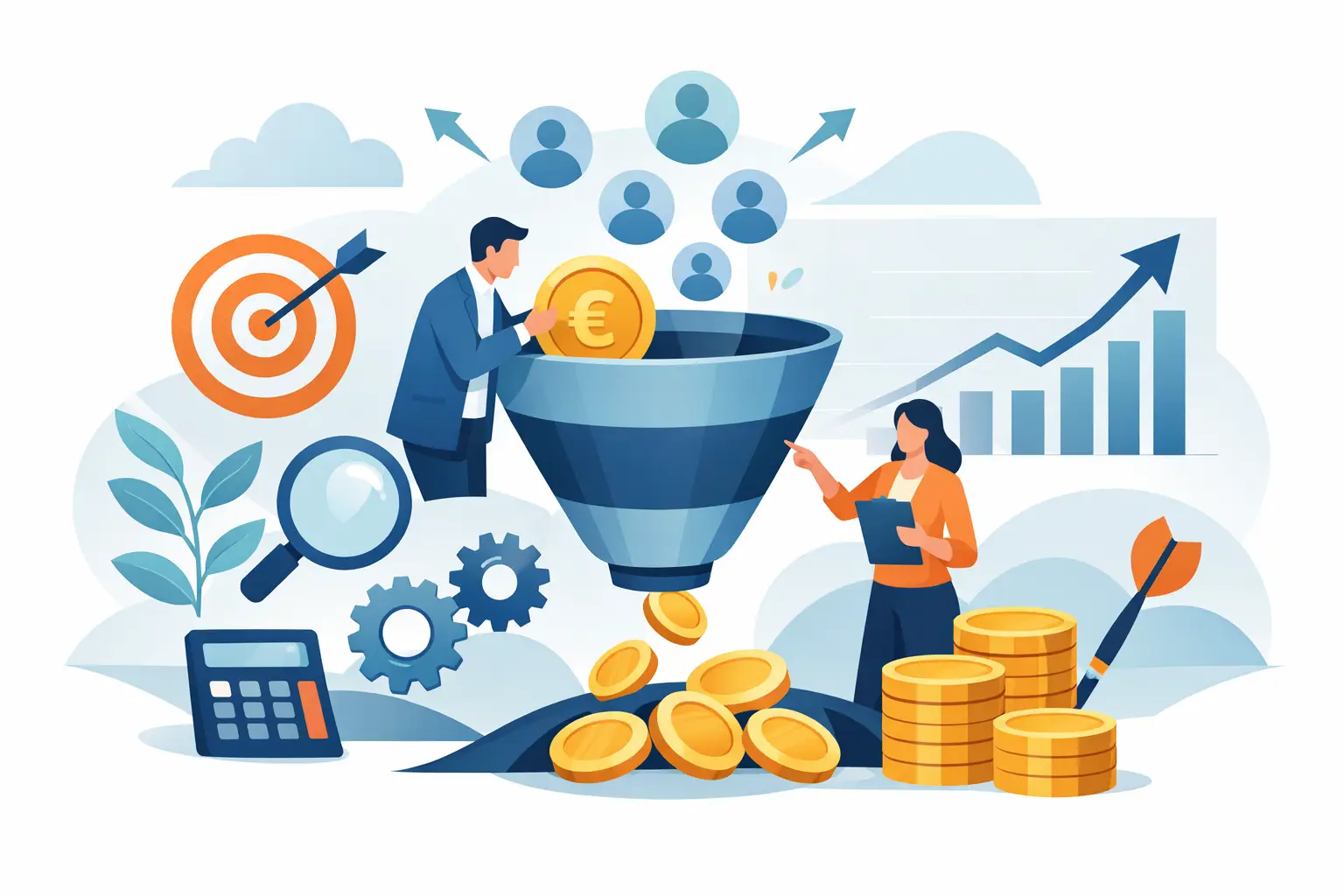
Are you paying 30, 50, or 100 euros per lead and wondering how to lower your cost per lead? Before you cut your budget, stop. Cutting spending without fixing the system leads to only one result: fewer leads, often of the same mediocre quality. The problem isn’t how much you pay for a completed form. The problem is how much revenue that lead generates and how much of your budget gets wasted on generic ads, slow-loading landing pages, and non-existent follow-ups.
A lower cost per lead is only useful if it doesn’t compromise sales quality. A 15-euro lead who doesn’t answer the phone is worth less than a 45-euro lead who becomes a customer. The goal isn’t to win a dashboard metrics race. It’s to build a sustainable, predictable lead generation process that provides the sales team with real opportunities.
Why the cost per lead is actually rising
CPL increases when the platform, message, page, and sales process aren’t aligned. Many companies blame it all on Google or Meta Ads: “Advertising costs too much.” In reality, they’re often driving qualified traffic to a page that doesn’t provide a clear reason to submit their information.
An ad may generate low-cost clicks, but if the Landing is slow, whether it’s confusing, full of self-referential content, or lacking a concrete proposal, every visit becomes a wasted opportunity. The same thing happens when the form asks for too much information, the contact doesn’t receive a response until the next day, or no one tracks which campaigns generate appointments and which ones just attract curious visitors.
Then there’s one mistake that’s more costly than all the rest: treating every lead as if it were the same. A complete quote request, a phone call, and a brochure download don’t have the same value. If you lump them all together, the numbers look reassuring, while the sales department ends up chasing after people who will never buy.
How to Reduce the Cost Per Lead by Starting with the Offer
Before you even get to the advertising settings, there’s a tough question: Why should someone reach out to you right now? “Quality, experience, and professionalism” aren’t a selling point. They’re words that everyone uses—including the competitors who are outperforming you.
An effective proposal makes the next step clear. For a B2B company, this could be a preliminary analysis with clear criteria, a customized configuration, or a quick estimate. For a local business, it could be a visit, a consultation, or a quote with a specific availability date. You don’t need to give away your work—you need to reduce the uncertainty for the person making the decision.
The more specific your offer is, the more you can use targeted ads and landing pages. And that specificity reduces waste. A message aimed at “all companies that want to grow” attracts costly clicks and vague inquiries. A message tailored to a specific industry, a specific problem, and a recognizable outcome filters out the wrong leads even before they reach the form.
Don't promise everyone the same thing
Segmenting doesn’t mean creating twenty useless campaigns. It means separating audiences with different needs when the offer, objections, and customer value change. A professional looking for clients in their own city doesn’t react the same way as a company looking for a CRM system to manage a sales network.
Start with the areas that generate the highest margins or have the fastest sales cycle. That’s where every improvement in CPL has a tangible impact. If a service line brings in low-cost leads but doesn’t close deals, it doesn’t automatically deserve more budget. It deserves a thorough review.
The landing page determines how much you pay for each lead
Directing people to the home page is convenient, but almost always inefficient. The home page has to appeal to a wide range of audiences, tell the company’s story, and offer various paths. A campaign, on the other hand, needs the opposite: a page focused on a single intent and a single action.
On the first screen, three things must be immediately clear: what the user gets, who the offer is intended for, and what they need to do to receive it. If they have to scroll, decipher slogans, or open five menus to figure this out, you’re paying to confuse people who are interested.
One a landing page that converts It’s not a page full of flashy effects. It’s a page that reduces friction. It explains the problem in the customer’s own words, presents the benefit without making miraculous promises, anticipates objections, and makes the request simple. If you’re selling a complex service, also include the process: what happens after the customer contacts you, how quickly you respond, and what information is needed to evaluate the case.
The form needs to be fine-tuned. Asking for name, email, and phone number can maximize volume, but it also lets in many weak leads. Adding one or two qualifying questions reduces the number of leads, but can increase appointments and sales. There’s no one-size-fits-all rule: it depends on the average customer value, the sales rep’s capabilities, and the number of inquiries you can handle.
Optimize your campaigns based on the signals that matter
Ad platforms do exactly what you tell them to do. If they’re optimized for form submissions, they’ll target people likely to submit forms—not necessarily people likely to make a purchase. To lower your CPL without filling your CRM with junk, you need to improve the signal you send to the platform.
At the very least, track the path from ad to lead to contact to appointment to sale. You don’t need to build a data center. You need to know which campaigns are generating the real opportunities. When this data is missing, the algorithm is operating blindly, and budget decisions are based on the most visible cost, not the most profitable outcome.
Also monitor actual search queries, ad creatives, and frequency. On Google, keywords that are too broad can attract users looking for free information or solutions that are unrelated to your offering. On social media, an ad creative that works for weeks can saturate your audience and stop performing. Don’t wait for costs to skyrocket: swap out angles, tests, visuals, and calls to action before the campaign runs its course.
A useful test is not an infinite one
Changing the audience, ad, landing page, and offer all at once isn't optimization. It's chaos. If the results improve, you don't know why. If they get worse, you don't know what to fix.
Test one variable at a time when you have enough data: the landing page headline, the ad angle, a question on the form, or a page dedicated to a specific segment. The goal isn’t to always have something to test. It’s to make better decisions with sufficient data, without letting the urge to change everything every day drive your actions.
A faster response time lowers the cost per actual lead
You can run excellent campaigns and still lose money the very minute after a conversion. A lead who fills out a form is a hot lead at that moment. Two hours later, they’re back at work, have heard from a competitor, or have forgotten they contacted you. Responding too late turns paid leads into wasted leads.
This is where CRM and notifications come into play, automatic assignments and follow-up sequences. The request must be followed by immediate confirmation, a clear assignment of responsibility, and prompt, personal contact when the service requires it. Automation does not replace sales; it prevents a potential sale from falling through because someone missed an email.
Measure the average response time and the effective contact rate. If 40% of leads aren’t followed up on within the same day, the priority isn’t to seek out a new audience on Meta. It’s to fix the internal process. Spending more to generate leads that you don’t follow up on is one of the most common false economies.
Look at the acquisition cost, not just the CPL
CPL is a performance metric, not the end goal. To determine whether a campaign is working, you need to consider it in relation to customer acquisition cost, average contract value, and margin. A higher CPL can be excellent if it generates larger, recurring, or easier-to-serve customers.
Let’s look at a simple example. Campaign A generates leads at 20 euros each and has a 2% conversion rate. On average, it takes 50 leads to acquire one customer, which amounts to a 1,000-euro investment. Campaign B generates leads at 40 euros but has an 8% conversion rate. It takes about 13 leads to acquire one customer, which amounts to 520 euros. Anyone looking only at the CPL would choose the wrong campaign.
This doesn’t mean ignoring costs. It means stopping the pursuit of the cheapest leads and starting to buy attention from people who can actually become customers. To do this, you need interconnected campaigns, web pages, CRM systems, and sales efforts. That’s why a dedicated technical and marketing department—like the one WebWakeUp builds for companies—is worth more than a campaign that’s launched and then abandoned.
The next time your cost per lead goes up, don't immediately ask yourself which lever to pull. Ask yourself where the journey from click to revenue breaks down. That's where the budget you're giving away to your competitors is hiding.