The problem isn't when the site breaks. The problem is everything you lose before you even realize it. A form that stops submitting requests, a page that loads slowly on mobile, a plugin that causes conflicts, tracking that stops working after an update: the damage happens silently, but in the meantime, it’s eating away at your leads, sales, and credibility. That’s why ongoing website technical support isn’t just a nice-to-have for large companies. It’s concrete protection for anyone who relies on digital channels to generate revenue.
Many entrepreneurs discover this truth too late. They invest in creating a website, put it online, and think the job is done. In reality, that’s when the part that really matters begins. A website isn’t a printed brochure. It’s a living system, consisting of updates, integrations, performance, security, compatibility, and conversion. If no one monitors it, it stops working for you long before it goes offline.
What Does "Ongoing Website Technical Support" Really Mean?
It means having someone who doesn’t just step in when there’s an emergency, but who constantly monitors, corrects, updates, and improves the website. We’re not talking about the typical maintenance done once in a while, just to install a couple of updates. We’re talking about an operational presence.
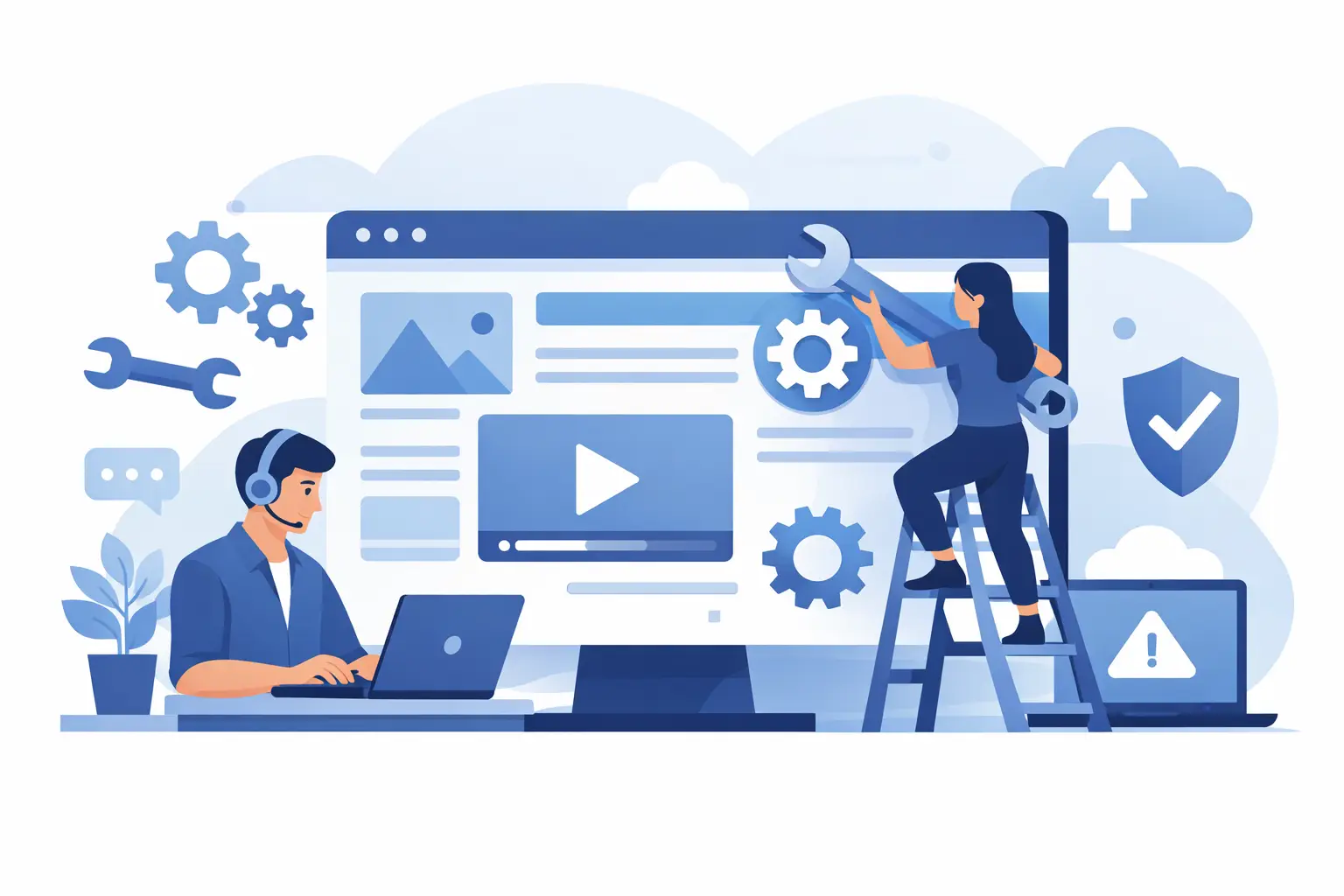
This includes managing CMS, theme, and plugin updates; checking for errors; monitoring site speed; verifying contact forms; ensuring compatibility with external tools; maintaining security; and, in many cases, implementing the iterative changes required by the business. If you change your offering, add a service, launch a campaign, or need to create a new landing page, your website must adapt accordingly. If it remains static, it becomes an obstacle.
The difference is simple: occasional maintenance keeps the site up and running. Ongoing support keeps it useful.
Why an unmonitored website costs more than it seems
The most common mistake is to evaluate a website solely based on its development cost. But the real cost is the cost of neglect. A neglected website quietly loses performance, and almost no one notices until results start to decline.
Here's a concrete example: you're investing in advertising, perhaps on Google or Meta. The campaigns drive traffic, but The landing page is slow, the form doesn't work well on smartphones, or Pixel doesn't track properly. You keep spending, but the machine is falling apart. You're not cutting corners on support. You're paying for traffic that doesn't convert.
The same applies to those working on organic search rankings. If the site has technical errors, broken pages, outdated plugins, or indexing issues, your visibility suffers. And when you go offline, you don't just lose visitors—you give your competitors a leg up.
Then there’s the internal operating cost. Without ongoing technical support for the website, every small change becomes a hassle. Who handles it? The owner, the sales rep, the cousin who “knows a little about it,’ or the freelancer who gets back to you after four days? In the meantime, the urgency remains. And when the digital world comes to a standstill, it waits for no one.
The False Savings of a "Set It and Forget It" Website
The market is full of websites sold as finished products. You pay for the project, receive the login credentials, and from there on out, you’re on your own. It seems like a cost-effective solution, but it’s often the opposite.
Because every subsequent update is billed separately. Every change takes a long time. Every problem becomes a new negotiation. And above all, there’s no long-term vision. No one is viewing the website as a business tool to be developed. Work is done on a per-ticket basis, not based on results.
This model only makes sense in limited cases—for example, for a static showcase website that doesn’t generate leads or support business activities. But if your website needs to capture leads, support campaigns, integrate with a CRM, automate requests, or support business growth, a one-time project is almost always a false economy.
A digital infrastructure that generates business requires constant presence. The issue isn't technical. It's economic.
When Ongoing Support Really Makes a Difference
There are times when the difference between having support and not having it is immediately apparent. If you launch a campaign and need to update a page within a few hours, quick support directly impacts your results. If you change your pricing, services, or promotions and the website remains outdated for a week, you’re sending the wrong message right when you’re trying to make a sale.
Even the invisible parts matter. An untested update can break key features. An expired certificate can undermine trust and block access. A poorly configured anti-spam module can cause you to miss legitimate requests. These problems are small only on paper. When it comes to revenue, they’re never small.
Ongoing support is also important when “nothing is happening.” In fact, that’s when it’s most important. Because the value lies not only in resolving incidents, but in preventing them and keeping the site aligned with the direction your business is taking.
Technical support and growth: two things that shouldn't be separated
This is where many companies get their perspective wrong. They view technical support as a maintenance cost and marketing as a separate line item. In practice, however, the two overlap on a daily basis.
If you want to improve conversions, you often need to make changes to pages, forms, site speed, tracking, calls to action, automations, and integrations. If you want your campaigns to perform better, you need to be able to quickly fix what isn’t working. If you want to track leads in an organized way, your website needs to integrate with CRM, email, calendar, or chatbot.
When technical support and growth operate in isolation, everything slows down. But when you have a structure that manages technology and performance together, the website stops being something that just needs to be maintained and becomes an asset to be grown.
That’s why a well-designed subscription model makes more sense than the traditional fixed-price model. You’re not just paying someone to “fix things.” You’re paying for consistent execution, speed, and the ability to adapt the digital system as the market changes.
How to Tell If You Need Ongoing Website Technical Support
The answer is almost always yes, but to varying degrees. If your website generates business inquiries, collects leads, supports campaigns, or contains critical parts of the sales process, you already need it. If, on the other hand, it’s a minimal presence that’s rarely updated and has little impact on your business, the question isn’t whether you need support. The question is whether that website is actually doing its job.
There are some very clear signs. You’re afraid to update anything because you might break the site. Every change takes too long. You don’t know if the forms are actually working. No one is monitoring speed, errors, or tracking. Campaigns launch, but the site isn’t optimized accordingly. Or, more simply, no one is consistently monitoring your digital ecosystem.
If you recognize yourself in even just two of these situations, you don't have a minor technical issue. You have an operational bottleneck.
What to Expect from a Reputable Service
A professional service isn't just about “being available.” It must have clear timelines, clear processes, and clear responsibilities. It must act quickly, but also in an organized manner. It must update without causing disruptions, make changes without slowing things down, suggest improvements when needed, and not disappear once the site goes live.
Transparency is also key. You need to know what’s included, what’s being monitored, and how priorities and requests are handled. Ongoing technical support isn’t just general on-call availability. It’s an external service that takes charge of the site as part of your operations team.
In this approach, it’s the mindset that makes the difference. Those who think solely like developers tend to see tickets. Those who think like partners see the impact: lost leads, missed opportunities, time-to-market, and the quality of the user experience. It’s a huge difference.
That’s why companies like WebWakeUp have developed a different business model: instead of simply selling a website and walking away, they provide ongoing support each month for technology, updates, marketing, and continuity. For many small and medium-sized businesses, this is the smartest way to have a technical and digital department without hiring in-house staff.
The point isn't to keep the site up and running
Keeping your website online is the bare minimum. The real goal is to make sure it works well—all the time—as your business evolves. A slow, outdated, or neglected website isn’t neutral. It holds you back. And when it holds you back online, your competitors won’t wait for you.
Ongoing website technical support makes sense precisely for this reason: it transforms the website from an upfront cost into an infrastructure that remains aligned with business objectives. Fewer unexpected issues, fewer hidden losses, and faster delivery of what’s truly needed.
If your website plays a role in generating customers, don’t treat it as a finished project. Treat it for what it is: a source of revenue that needs to be monitored, refined, and continuously improved. Because online, it’s not the one who publishes who wins. It’s the one who stays on top of things.