Every time a contact reaches out to you and no one responds in time, you’re not just missing a message. You’re giving away a deal. This is where marketing automation for small and medium-sized businesses stops being just a buzzword and becomes a real competitive advantage: fewer manual steps, fewer missed opportunities, and greater business continuity.
The point isn’t to automate everything. The point is to automate the things that are currently costing you time, profit, and customers. Many small and medium-sized businesses face a simple problem: leads come in sporadically, are poorly managed, and get scattered across WhatsApp, email, Excel spreadsheets, and the sales rep’s memory. Then they wonder why their advertising “doesn’t work.” In reality, it’s often not a lack of traffic. It’s a lack of a system.
Marketing Automation for SMEs: What It Really Means
For an SME, marketing automation isn’t about filling your website with useless chatbots or sending impersonal newsletters every three days. It’s about building a workflow that guides potential customers from their first contact through to a sales inquiry—and beyond.
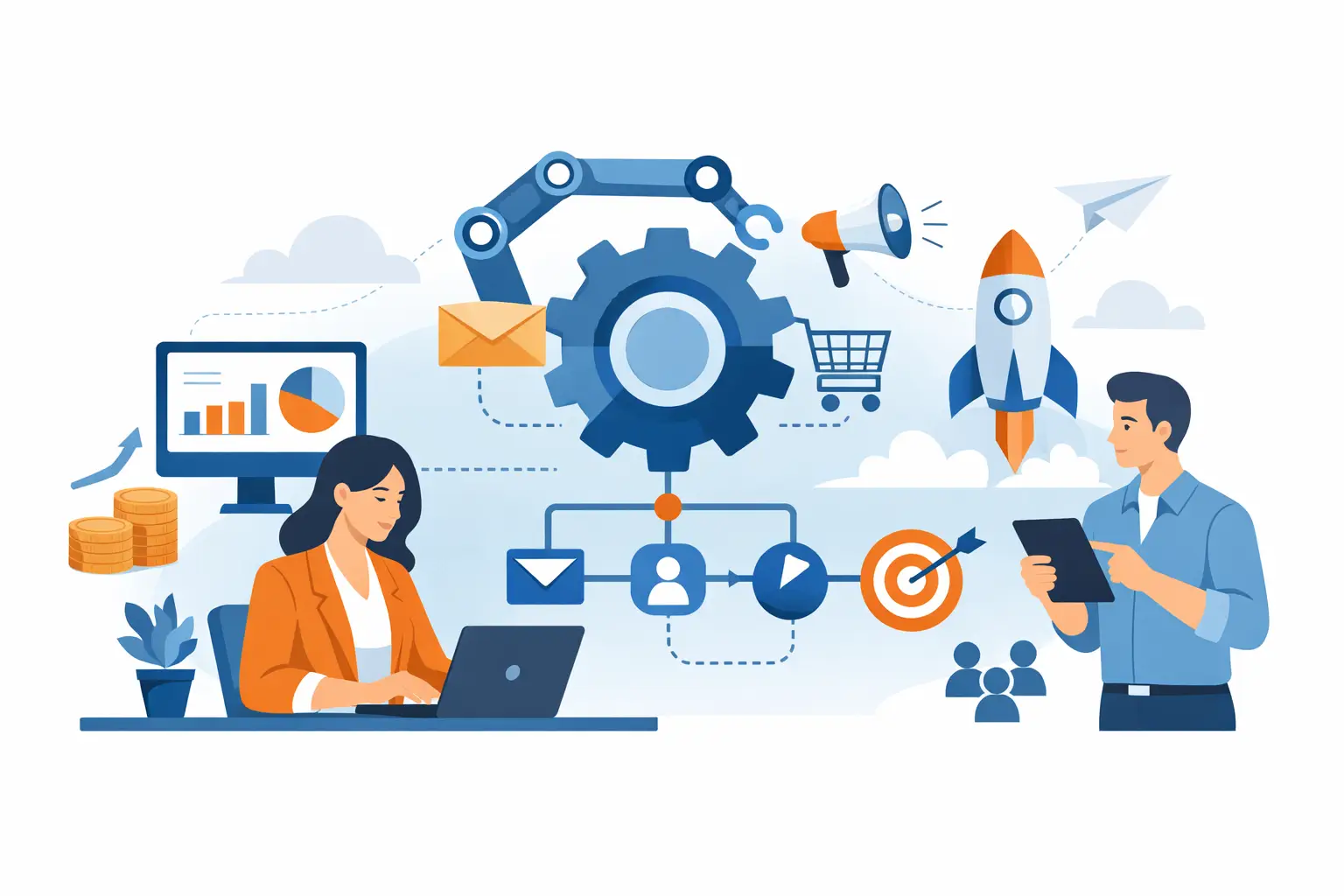
If a person fills out a form, the system can log them into the CRM, assign them to the right sales representative, send an immediate response, trigger an internal reminder, and activate a follow-up sequence. If a contact visits a key page but doesn’t convert, they can receive targeted content or an invitation to schedule a call. If a customer makes a purchase, they can enter a support, upsell, or reactivation workflow. This is useful automation. The rest is just noise.
The real difference lies here: marketing doesn’t stop when you turn off your computer. It keeps working—logically, at the right times, and with less wasted effort.
Where automation really pays off
SMEs often look for shortcuts, but automation isn’t a shortcut. It’s a multiplier. It works well when there’s already a clear offering, a minimum level of demand, and a willingness to treat digital as a business process, not as an experiment.
The first area where it makes a difference is response time. People who fill out a form today expect an immediate response, not tomorrow morning. Even a well-written automated message, followed by actual follow-up, increases the likelihood of conversion. Not because it replaces the salesperson, but because it prevents the lead from going cold.
The second is lead qualification. Not all leads are created equal. A well-designed workflow can gather useful information, segment leads, and ensure that only the most promising or ready-to-buy leads are passed on to the sales team. This reduces wasted time and improves the closing rate.
The third is follow-up. This is where huge amounts of business are lost. Many companies invest in generating leads but then lack a system to follow up with them in an organized manner. That’s exactly what automation is for: keeping the relationship alive without relying on someone’s memory.
Finally, there’s customer service, which many SMEs tend to overlook. An existing customer is worth far more than a cold lead. Automating review requests, additional offers, renewals, and reactivations means increasing customer value over time. And this has a direct impact on revenue.
The processes to automate first, without wasting months
The classic mistake is trying to design a perfect machine before you even have a solid foundation. It’s not necessary. To get off to a good start, all you need are a few high-impact processes.
The first is lead generation. Forms, landing page, campaigns and CRM systems need to communicate with each other. If a new contact comes in today and someone has to copy the data by hand, you’re already behind.
The second is the initial response. It includes an acknowledgment of receipt, a personalized message, internal assignment, and perhaps a link to schedule an appointment. These are simple automations, but they make a big difference.
The third is following up on unclosed leads. Just because someone doesn’t buy right away doesn’t mean they’re lost. Often, they’re just in the wrong place at the wrong time. A well-designed follow-up sequence can bring them back into negotiations in a week or a month.
The fourth is internal management. Automation isn’t just for external processes involving customers; it’s also needed internally. Automated tasks, notifications, status updates, and handoffs between departments help prevent bottlenecks that slow everything down.
When marketing automation for SMEs Doesn't Work
To say that automation always works would be nothing more than marketing hype. That’s not the case.
If your offer is unclear, automation will only make the problem worse. If your The site isn't converting, simply setting up an email sequence won’t save the day. If traffic is low or completely off-target, you’re just automating a dead end. And if the sales team isn’t following up with anyone, no software can work miracles.
There’s another point to consider: too much automation can damage the relationship. A poorly written automated message is immediately obvious. A persistent sequence of messages is irritating. A chatbot that gets in the way instead of helping drives people away. The rule is simple: automate the process, not the relationship. The relationship needs to be nurtured, not stripped of its humanity.
That’s why successful SMEs aren’t looking for tools to accumulate. They’re looking for an ecosystem that includes a website, CRM, advertising, funnel and follow-ups are coordinated. Software alone does not generate sales. It creates processes. Sales happen when those processes are designed around a clear business objective.
Tools are important, but strategy comes first
Many business owners ask the same question: Which platform should I use? It’s a valid question, but it’s often asked too soon. First, you need to understand what you want to achieve, where you’re missing out on opportunities today, and which processes you can streamline without compromising quality.
For some SMEs, a streamlined setup is sufficient: a landing page, CRM, forms, automated emails, and an appointment calendar. For others, a more sophisticated solution is needed, with integrations between advertising, lead scoring, sales pipelines, and post-sales automation. It depends on the volume of leads, the complexity of the sales process, and the average customer value.
The key isn't having ten tools. It's having a system that your team actually uses. If a solution is powerful but no one updates it, you've bought complexity—not growth.
The Real Comparison: In-House Staff, DIY, or a Business Partner
Let’s be honest here. Marketing automation for SMEs requires a wide range of skills: strategy, copywriting, tracking, CRM, advertising, UX, and business logic. Thinking that all you need to do is “set up a few automations” is the surest way to waste money without seeing a return.
Doing it yourself only seems cheaper at first glance. Then come configuration errors, disorganized data, workflows that don’t launch, campaigns disconnected from the CRM, and weeks wasted trying to figure out why leads aren’t being managed properly. Even hiring an in-house person rarely suffices on its own: a single person can hardly cover the website, campaigns, funnels, automations, and ongoing maintenance while maintaining a high standard across the board.
That’s why many companies prefer an external partner that acts as an ongoing technical and marketing department, rather than an agency that delivers the project and disappears. When the model is right, you’re not just buying execution. You’re buying ongoing support, rapid response, and a structure that adapts as your business evolves. It’s also why companies like WebWakeUp push for a subscription-based approach: less upfront risk, more operational continuity, and a greater focus on actual financial results.
How to tell if you're ready to go
If you’re receiving inquiries today but don’t have a consistent response time, you’re ready. If you’re investing in advertising but don’t know how many leads turn into customers, you’re ready. If your sales team follows up with leads “whenever they can,” you’re ready. If every step depends on a person rather than a process, you’re ready.
You don’t have to be a large company to automate. In fact, SMEs often have more to gain because they start with inefficiencies that are easy to fix. Just a few well-designed automation solutions are enough to streamline day-to-day operations and measurably increase conversion rates.
So the right question isn’t whether automation is right for you. It’s how much it costs you to keep going without it. Because every ignored lead, every forgotten follow-up, and every repetitive manual process aren’t just operational details. They’re profits walking out the door.
If you want to take a sensible step, don’t start with the tools or the aesthetics. Start with the points where your business process breaks down. That’s where automation stops being just technology and starts driving growth.