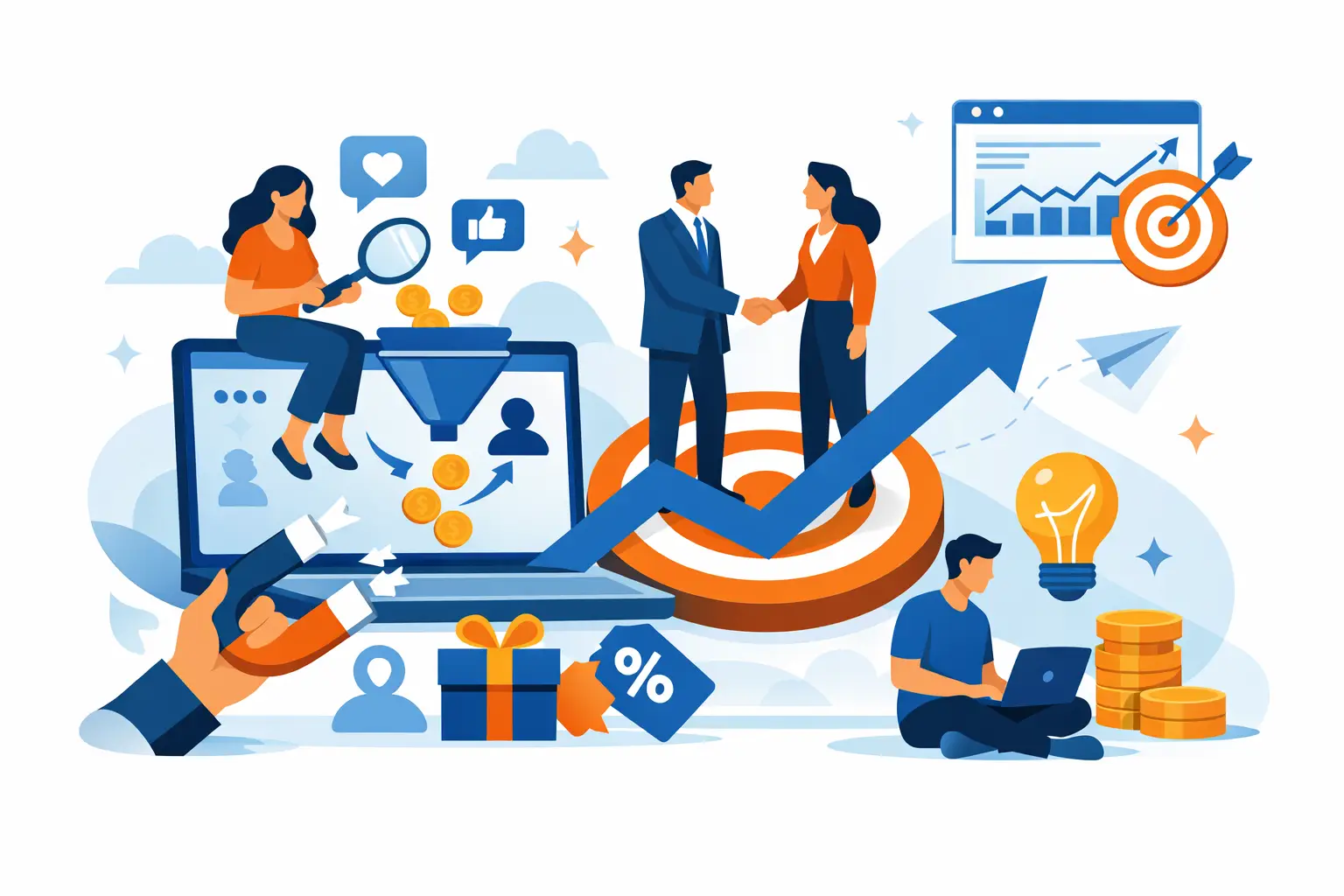
If your website is getting traffic but the phone isn’t ringing, the problem isn’t the traffic. It’s what happens after the click. Talking about strategies to increase conversions means stopping to obsess over graphics, vanity metrics, and personal insights, and starting to focus on just one thing: how many users turn into leads, inquiries, appointments, quotes, and sales.
The truth is less convenient than many are willing to admit. Often, we don’t need more campaigns. What we need is a system that loses fewer people along the way. Every unnecessary step, every vague message, every slow-loading page, and every missed follow-up is already eating into our margin. And that margin is most likely going to our competitors.
Strategies for Increasing Conversions: Where to Really Start
It all starts with a simple question: What do you want the user to do? It sounds obvious, but so many websites ask users to do too many things at once. Schedule a call, download the brochure, message us on WhatsApp, fill out the form, follow us on social media. The result: no clear priority, so no action is taken.
A high-converting page has one primary goal. Just one. If you’re selling a high-value service, a realistic goal might be a contact request or scheduling a call. If you’re offering a simpler product, it might be a direct purchase. Mixing different goals almost always lowers the conversion rate.
This is where the first trade-off comes in. Reducing your options increases the likelihood of taking action, but it requires courage. It means giving up some “nice-to-have” elements to make room for what generates revenue.
1. Make your offer clear within the first 5 seconds
The user shouldn't have to guess. They need to understand right away what you do, who you do it for, and why they should choose you. If the message above the fold is generic, you've already lost ground.
Phrases like “innovative solutions for your business” don’t help anyone. A concrete message is much better: service, target audience, benefit, and timeframe or expected result. You’re not trying to win a creativity award. You need to eliminate doubts.
A good value proposition reduces anxiety and shortens the decision-making process. If, on the other hand, the visitor has to wade through sections, sliders, and vague slogans, they’ll leave. Not because the service is poor, but because the website isn’t presenting it well.
2. Reduce friction at every stage of the funnel
Many companies believe they have a persuasion problem. In reality, they have a friction problem. The form is long, the site is slow, it’s hard to read on mobile, the call to action is weak, and the page seems designed to please the owner rather than prompt the customer to take action.
Strategies for increasing conversions work when they eliminate invisible barriers. Ask for as little information as possible during the first contact. If you can get a name, email address, and phone number, don’t add ten fields “to better profile” the lead. In practice, that kind of profiling often destroys lead volume.
The same applies to speed. A slow website It's not just a technical issue. It's a business cost. Every extra second degrades the user experience and reduces the likelihood that the user will complete the request.
3. Make sure the ad copy matches the landing page
One of the most costly mistakes is promising one thing in the ad and having the landing page offer something else. If the ad mentions free consulting for professional firms, the page must continue along exactly that line of thought. Don’t redirect the user to the homepage and hope they’ll figure it out on their own.
Consistency in messaging builds trust and drives conversions. Users need to feel like they’re in the right place, without having to mentally piece together the puzzle. This applies to Google Ads, Meta Ads, email, and organic traffic.
The more urgent the intent, the less it tolerates deviations. Users coming from a specific search or a well-targeted campaign want immediate confirmation. If they don’t find it, they close the page. And the budget keeps burning through.
4. Use concrete evidence, not self-praise
Just saying you're reliable, fast, or professional isn't enough. Everyone says that. Trust is built on verifiable facts: real-life examples, numbers, reviews, results, examples of processes, response times, a cohesive portfolio.
Here, too, balance is key. Too many testimonials thrown in at random come across as filler. A few relevant ones work better. If your target audience consists of entrepreneurs and small and medium-sized businesses, they want to know if you’ve already solved problems similar to theirs. They aren’t looking for generic, enthusiastic phrases. They’re looking for signs that the risk is reduced.
The right social proof doesn't just say, “We're good.” It says, “We know how to operate in your context, and we can save you time, mistakes, and money.”.
5. Create calls to action that encourage the next step
A weak call to action is an invitation to procrastinate. “Submit” is weak. “Contact us” is often too vague. Users are more likely to click when they understand what they’ll get and what will happen next.
“Request a consultation,” “Schedule a 15-minute call,” and “Get an assessment of your funnel” are more effective phrases because they reduce ambiguity. They make the value of the next step clear.
Aggressiveness isn't always necessary. In some markets—especially high-ticket B2B markets—a CTA that's too pushy can seem premature. But clarity and specificity are still essential.
6. Segment your traffic instead of directing it all to the same place
Directing different users to the same page is a shortcut that costs you conversions. An entrepreneur looking for a website, someone seeking leads from campaigns, and someone who needs automation don’t all have the same question in mind. If you treat them all the same, your message loses its impact.
Segmenting doesn't mean making the system endlessly complicated. It means creating consistent pathways for different objectives. Sometimes all it takes is a few well-designed landing pages, with value propositions, objections, and CTAs tailored to the specific need.
This approach also improves the quality of leads. You may receive fewer total inquiries, but they’ll be more relevant. And that’s often where the ROI really makes a difference.
7. Address objections before the user raises them
Price, timing, reliability, complexity, support, expected results. Objections don’t disappear just because you avoid mentioning them. They linger in the visitor’s mind and prevent them from taking action.
A page that converts addresses potential concerns upfront. It explains how the service works, what’s included, how quickly you can get started, what happens after you contact us, and which results are realistic and which aren’t. This last point is very important. Overblown promises may boost click-through rates, but they often hurt the final conversion rate and the quality of the sales process.
People who buy digital services today are more skeptical than they used to be. They’ve seen too many agencies disappear after delivery or too many half-baked solutions. That’s why operational clarity almost always trumps vague marketing.
8. Automate your follow-up, or you'll lose leads you've already paid for
Here, many companies let opportunities they’ve already secured slip away. A lead reaches out, but no one gets back to them promptly. Or a generic response is sent hours later, by which time the lead has already filled out three other forms.
If you want to increase conversions, the work doesn't end with lead generation. It starts there. Immediate confirmation, internal assignment, reminders, qualification, tracking, and potential nurturing: Follow-up must be a process, not a favor that someone happens to remember to do.
For many SMEs, this is the difference between having campaigns that “don’t work” and having a sales system that actually converts. Without operational continuity, even the best traffic goes to waste.
9. Measure what matters, not what looks good
If you're only tracking visits, impressions, and likes, you're looking at the wrong metrics. The useful metrics are different: conversion rate per page, cost per lead, lead quality, response rate, appointments scheduled, sales generated, and average contact time.
Data helps us decide where to take action. If a landing page gets clicks but doesn’t convert, the problem lies with the page itself or its alignment with the traffic. If leads come in but aren’t closed, the problem could be the sales process, the offer, or the initial qualification. If the cost per acquisition rises, you don’t always have to cut your ads. Maybe you need to adjust the funnel.
Without this perspective, you end up with the same old routine: you change the design, redesign the logo, and rebuild the website from scratch—and revenue stays the same.
The point that many people overlook: conversion isn't a single element—it's a system
Those looking for shortcuts often focus on just one small element: a button, a color, a title, or the latest tool. Sometimes small tests can lead to real improvements. But when the problem is structural, tweaking details does little good.
Conversion results from the alignment of traffic, message, page, offer, contact process, and follow-up. If any one of these elements falls short, the rest can’t fully compensate. That’s why doing it yourself often turns out to be a false economy: you save money at first, but you keep missing out on opportunities every month.
For many Italian companies, the key isn’t simply having “more marketing.” It lies in having a digital ecosystem that is continuously monitored, adjusted, and improved. This is also why ongoing operational models, such as WebWakeUp’s, make more sense than one-off projects that are delivered and then abandoned. Digital marketing that drives conversions isn’t a one-time effort. It requires ongoing management.
If you’re currently driving traffic to pages that aren’t convincing, or collecting leads without a quick process to turn them into customers, the problem isn’t tomorrow. It’s right now. Every week that goes by without fixing these issues isn’t a break. It’s revenue you’re leaving on the table.