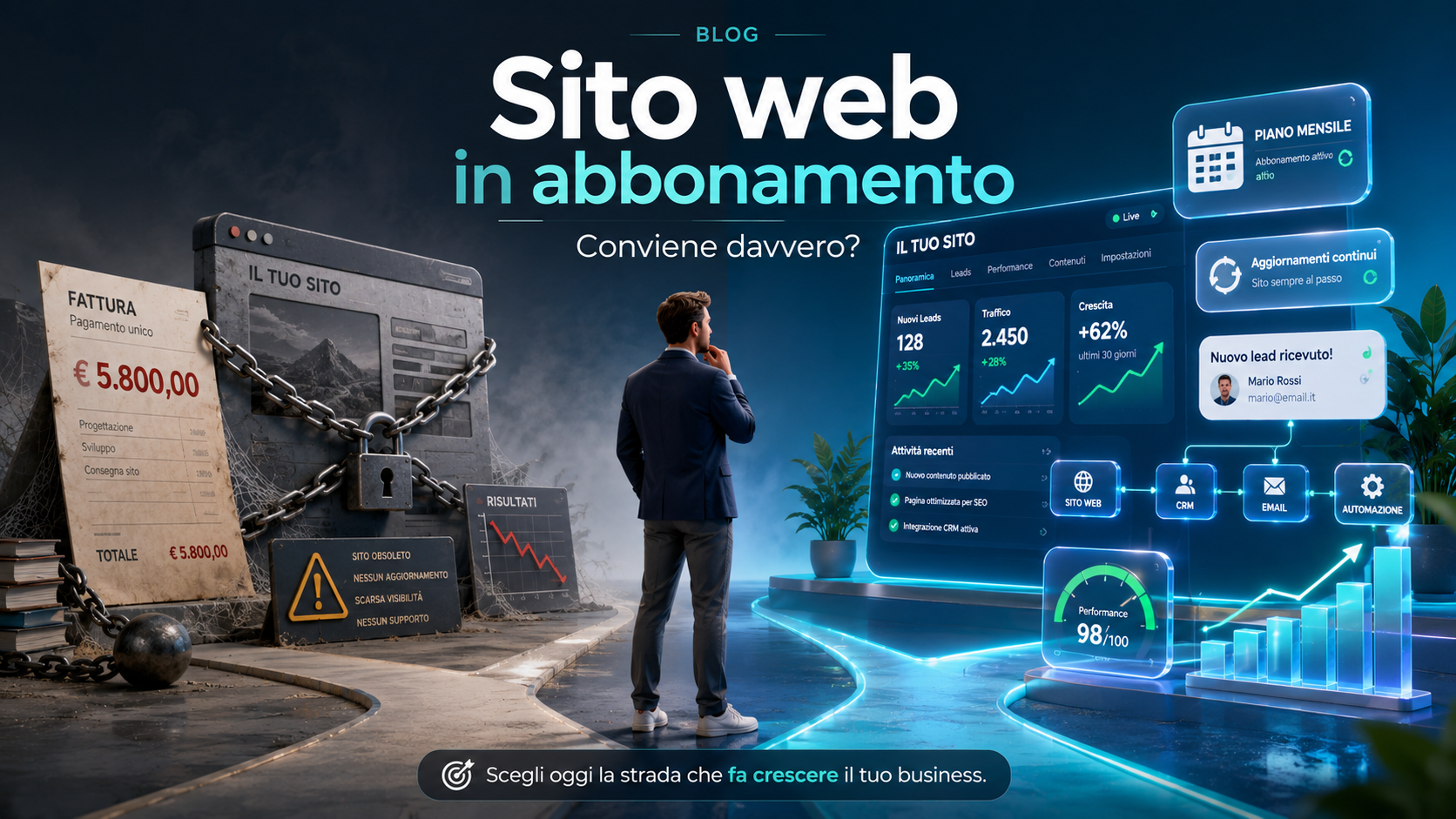
If your website is currently down, slow, outdated, or simply ineffective at generating leads, the problem isn’t just technical. It’s a business issue. A subscription-based website was created precisely for this reason: to stop treating your website as a one-time expense and start managing it as a tool that must deliver results month after month.
Many business owners make the same mistake over and over again. They pay for a project, receive the website, launch it, and think the job is done. Then six months go by, and what almost always happens occurs: no one updates the content, no one improves the pages, no one fixes the bottlenecks, and no one integrates campaigns, CRM, or automation. The website just sits there. Pretty, maybe. Useful? Not so much.
The point is simple: the web doesn't work well when it's treated as a one-way street. It works when it's actively managed.
What Is a Subscription-Based Website, Really?
A subscription-based website isn’t just a different way to pay for a website. If it were merely a matter of paying in installments, little would change. The real change lies in the business model.
With the traditional model, you pay a initial project, often requiring a significant investment, and then every change becomes a separate quote. If you want to add a landing page, redesign a section, or make adjustments tracking Or, if you want to improve performance, you’ll have to start over with tickets, long wait times, and new costs.
With a subscription, however, the website isn’t treated as a finished product but as an evolving infrastructure. It involves development, maintenance, updates, support, and often an ongoing strategic component as well. This changes everything, because the website stops being an online brochure and becomes a lead-generation machine that needs to be kept running efficiently.
For a company, this means one very concrete thing: less upfront investment and greater operational continuity.
Why the one-time payment option often ends up costing you more
On paper, buying a website once seems like the most economical choice. In reality, it’s often the opposite.
The first cost is the obvious one: design, development, and launch. Then come the costs that almost no one clearly considers: hosting, updates, bugs, optimizations, business changes, new pages, technical adjustments, integrations with external tools, and support when something breaks. At that point, the website is no longer a one-time purchase. It’s a structure that requires constant attention.
And that’s where the real problem lies. If you don’t have an in-house team, every little request turns into a negotiation. If you’re working with an agency that’s already been paid for the project, your website often slips to the bottom of their priority list. If you do it yourself, you waste time on tasks that don’t generate revenue.
That’s the whole point of false economy. You save money at first, but end up paying for it later in the form of delays, missed opportunities, and leads that go uncollected.
When a subscription-based website makes sense
It’s not a one-size-fits-all solution. It makes the most sense when the website is actually driving business.
If you acquire customers through online searches, advertising campaigns, digital word-of-mouth, or lead funnels, you need a structure that can be quickly adapted. Offers change, services shift, campaigns need to be aligned with pages, forms need to be tested, and tracking needs to be monitored. In these cases, continuity is more valuable than the theoretical ownership of a “finished” project.
It also makes a lot of sense for small and medium-sized businesses, professionals, and local businesses that don’t want to hire an in-house team but still need someone to monitor their website, performance, and operations. In short, they gain time, expertise, and quick response times without having to shoulder the fixed overhead costs associated with a larger company.
On the other hand, if you have a purely institutional website with content that rarely changes and no real need for lead generation, the subscription model might be less of a priority. It depends on how much support you actually need. The point isn’t the label. The point is how much your business depends on its digital presence.
The Real Benefits of a Subscription-Based Website
The first advantage is cost predictability. Instead of facing a large upfront expense, you spread the investment out over monthly payments. For many businesses, this is a smart cash-flow decision, not a shortcut.
The second factor is speed. If your market is constantly changing, you can’t wait weeks to update a landing page or fix a mobile issue. Having a partner who’s already up and running cuts down on time and friction.
The third point is that the website stays up-to-date. This matters more than it might seem. A website that evolves converts better, communicates more effectively, and keeps pace with the company’s growth rather than falling behind.
Then there’s an often-overlooked benefit: integration. A website on its own is only useful to a certain extent. When you connect it to CRM systems, tracking tools, and automation, chatbot, campaigns, and funnels, it ceases to be merely a container and begins to play an active role in the sales process. This is where digital becomes a driver of revenue.
Factors to consider before making a choice
To say that a subscription site is always worth it would be an easy marketing pitch. And it wouldn't be very serious.
The first thing to understand is what the fee actually covers. Some offers seem affordable but only cover the basics: a basic website, hosting, and little else. If every change is billed separately, you’re not buying continuity. You’re just changing your payment method.
Second point: review the terms and conditions. Minimum contract term, termination conditions, domain management, content ownership, technical access, and migration options. A good model should make your life easier, not tie you down with opaque terms.
Third point: Results matter, not promises. If your partner doesn’t have a concrete plan for lead generation, conversion, and rapid support, you risk paying for a subscription just to keep a website online that remains unproductive.
Subscription-based website or traditional website?
The right choice depends on how you think about digital technology.
A traditional website can make sense if you have static needs, in-house expertise, and the budget to handle everything else. Basically, you purchase the website and take care of maintenance, future developments, and optimization yourself.
A subscription-based website, on the other hand, is a better fit if you want ongoing support and prefer to pay for a system that stays up to date over time. You’re not just buying web pages. You’re buying operational continuity.
This brings us to an uncomfortable but useful question: do you just want to have a website, or do you want it to actually work?
Because if you just want to “have an online presence,” a standard solution may be enough. But if you want to generate leads, improve conversion rates, and adapt quickly to the market, the model takes on a whole new value.
How to tell if an offer is legitimate
A professional proposal doesn’t just focus on the visuals as if that were the heart of the matter. It discusses objectives, timelines, the project’s progress, and its impact on the business.
Always ask how monthly updates are handled, what services are included, what kind of support you’ll receive, how results are measured, and whether the site can integrate with sales and advertising tools. If the answers are vague, the risk is clear: you’re buying a product, not a partner.
The reverse is also true. When you find an organization that operates like an in-house technical and external marketing department, the fee shouldn’t be viewed merely as a recurring expense. It should be seen as ongoing access to expertise that, if handled internally, would cost much more and take longer to coordinate.
This is where a model like the one offered by WebWakeUp becomes appealing to many businesses: not because it “lowers” the cost of the website, but because it transforms the website into an active part of a broader system comprising campaigns, funnels, automations, and ongoing support.
The right question isn't how much it costs
The real question is: how much does it cost you to stand still?.
If your website doesn’t generate leads, doesn’t support your campaigns, doesn’t keep up with changes in your offerings, and is never optimized, then it’s not an asset. It’s dead weight. And online, dead weight comes at a silent cost: less visibility, less trust, fewer leads, and fewer sales.
A subscription-based website makes sense when it reduces this waste and enables you to respond quickly. Not because the monthly fee is convenient, but because today, speed of execution and continuity matter more than the initial delivery.
If you’re considering this option, don’t just look at the price. Look at the support, responsiveness, ability to adapt the project, and above all, how closely it aligns with your real goal: generating business, not just filling up the internet.
Because the right website isn't the one you publish. It's the one that keeps working even after it's published.