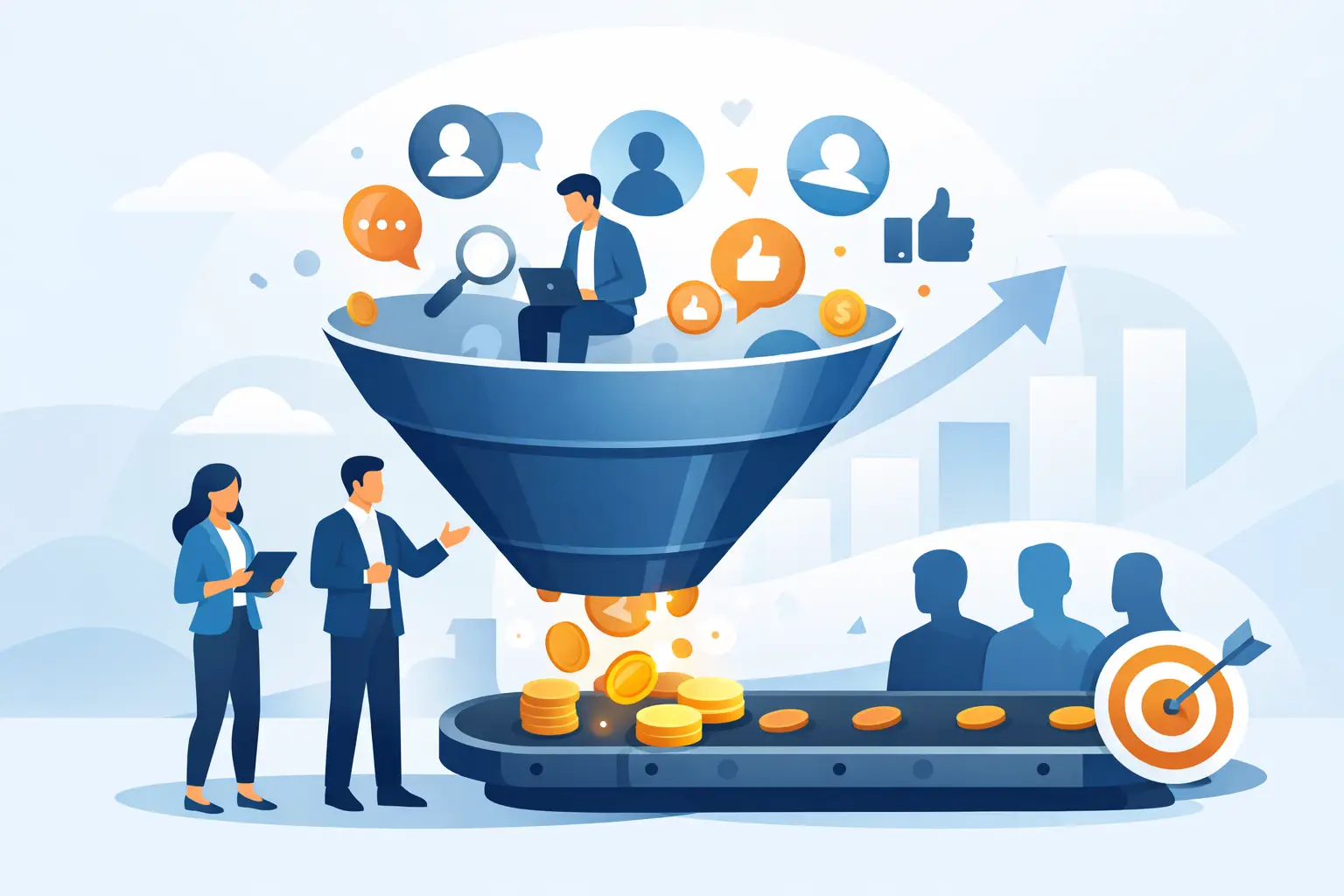
If you’re driving traffic to your site but not getting any leads, the problem is often not your budget. It’s your customer acquisition funnel. Many companies invest in ads, SEO, or social media and then leave the user hanging: a generic homepage, no sequence, no follow-up, no system to guide the decision. The result: you pay to get visitors and hand your leads over to your competitors.
What Is a Customer Acquisition Funnel, Really?
A customer acquisition funnel isn’t just a diagram with three colored arrows. It’s a business operating system. Its purpose is to take a cold prospect, turn them into a qualified lead, and guide them toward an inquiry, a call, or a purchase through a clear path.
Here’s what many people don’t realize: a funnel isn’t just about conversion. It’s about filtering. If you attract just anyone, you’ll end up with low-quality leads, waste time on pointless calls, and burn through your budget. A well-designed funnel improves the quality of your leads, not just the quantity.
That's why one isn't enough landing page That's right. There needs to be consistency between the message, the offer, traffic, automation, and the sales process. If any one of these elements breaks down, the funnel stops generating revenue and becomes a cost disguised as marketing.
The stages of the customer acquisition funnel
Every effective sales funnel has at least four stages. The first is awareness. Here, you tap into latent or explicit demand through Google Ads, Meta Ads, organic content, local SEO or targeted campaigns. The second factor is interest: the user lands on a page that promises a specific solution, not an endless list of services.
Then comes the conversion. Here, you ask for a specific action: filling out a form, scheduling a call, requesting a quote, or downloading a resource. If you ask for too much too soon, your conversion rate drops. If you ask for too little, you end up with low-quality leads. It’s always a matter of balance.
The final stage is the follow-up. And this is where so many companies fall short. A lead left unattended for 24 or 48 hours is worth much less. If there’s no email sequence, an up-to-date CRM, a notification to the sales rep, or a quick follow-up, the funnel breaks down just when the lead was at its hottest.
Traffic without a funnel is just noise
Let’s be blunt: buying traffic without a funnel is a false economy. It may seem like a practical move, but in reality, you’re just accelerating a loss. The more visitors you bring into a weak system, the more money you waste.
That’s why SMEs that achieve consistent results don’t think in terms of isolated tools. They don’t say, “Let’s run some ads” or “Let’s redesign the website” as if that were enough. They think in terms of the conversion funnel. Where does the lead come from, what do they see, why should they trust us, how long does it take for them to convert, who follows up with them, and through what process.
How to Build a Funnel That Brings in Real Customers
Start with the offer, not the design. If the message is vague, the funnel won’t hold up. “Customized solutions for every need” doesn’t sell anything. An effective funnel promises a concrete result to a specific audience. The clearer the positioning, the better the conversion.
Next comes the landing page. The rule here is simple: one page, one goal. If a user arrives from a campaign to request a site visit, you shouldn’t distract them with ten menus, a portfolio, a blog, and corporate pages. You need to guide them toward taking the intended action, minimizing friction and doubts.
The third element is proof. Reviews, real-life cases, statistics, examples, and results achieved. People don’t buy just because you have a modern website. They buy when they realize you’ve already solved a problem similar to theirs. Without proof, the sales funnel remains nothing more than a promise.
Then there’s lead generation. This is where many people make mistakes due to overzealousness. Endless forms lower conversion rates. Forms that are too sparse lead to more unnecessary leads. In some industries, a name, email address, and phone number are sufficient. In others, it’s worth adding one or two qualifying questions. It depends on the value of the service, the sales cycle, and the internal capacity to manage leads.
Automation and speed make all the difference
A funnel that stops at the contact form is incomplete. After the conversion, something needs to happen—immediately. An automated confirmation email, assignment to the CRM, a notification to the sales rep, a reminder, a WhatsApp message if applicable, or a nurturing sequence. Speed increases the conversion rate and reduces drop-off.
This is where the operational side of things comes into play—something many companies underestimate. If processes remain manual, the sales funnel holds up as long as there are only a few leads. But when the volume increases, everything falls apart. Forgotten requests, slow responses, missed appointments. It’s not a problem with creative marketing. It’s an infrastructure problem.
The mistakes that cause you to lose customers every day
The first mistake is driving traffic to the homepage. The homepage is meant to introduce your business, not necessarily to convert a specific campaign. If someone is looking for a specific solution, they want to land on a specific page.
The second mistake is measuring only clicks. Clicks don’t pay the bills. What matters are qualified leads, cost per lead, appointment rate, close rate, and average customer value. If you focus solely on the cost of traffic, you’re looking at the least useful metric.
The third mistake is believing that a sales funnel is a one-time project. It isn’t. A sales funnel needs to be tested, refined, and updated. Advertising costs change, user behavior changes, and competitors’ offers change. If you leave it untouched for months, it stops performing.
The fourth mistake is separating marketing from sales. If the sales team doesn’t know how to manage leads, the sales funnel gets blamed for things that aren’t its fault. If you’re getting good leads but no one follows up properly, no landing page can save you. The sales funnel generates opportunities. The final conversion also depends on how those opportunities are handled.
How complex should a funnel be?
Less than you think, but more than you’re doing now. You don’t need to set up a corporate-level infrastructure to get started. In many cases, all you need is a well-targeted campaign, a solid landing page, a clear offer, a CRM with basic automation and a quick follow-up.
Complexity increases as the value of the service rises or the decision-making process lengthens. A local professional offering consulting services can convert leads using a direct sales funnel. A B2B company with higher-value deals may need educational content, retargeting, email sequences, and progressive qualification.
The point isn't to do a lot. The point is to build the most effective system possible and then let it evolve. This is where many companies make a mistake with their investments: they spend too much upfront on the visual aspects and too little on the strategic and operational aspects.
How to Tell If Your Funnel Is Really Working
The answer isn’t simply “we’re getting visitors.” A funnel works if it generates leads that align with your business at a sustainable cost. This means analyzing certain metrics with discipline: page conversion rate, cost per lead, response time, appointment conversion rate, closing rate, and return on investment over time.
You also need to look for qualitative signals. Are the leads asking the right questions, or do they seem to have stumbled upon your site by chance? Do they already have a clear idea of the problem you solve, or do they ask you about everything under the sun? If you’re getting a lot of traffic but the quality is low, the problem may lie in your targeting, your message, or your initial promise.
Here’s another very concrete indicator: does the funnel make your job easier or harder? If your team is wasting hours chasing cold leads, sifting through scattered data, and handling manual follow-ups, the system isn’t working for you. It’s just giving you the illusion that you’re doing marketing.
Why the traditional model is often no longer enough
Many companies still rely on an outdated approach: they redesign their website, run a campaign for a month, collect a few leads, and then stop. It’s a stop-and-start approach. The market, on the other hand, rewards consistency. A customer acquisition funnel pays off when it is monitored, improved, and integrated with tools that leave no stone unturned.
This is also why a long-term operational partner has a greater impact than a vendor who delivers and then disappears. When websites, landing pages, advertising, CRM, and automation work together, digital marketing stops being a hard-to-decipher cost item and becomes a measurable business engine. WebWakeUp has built its model precisely on this principle: fewer isolated projects, more infrastructure that delivers results over time.
If your current marketing strategy is driving traffic but isn’t consistently bringing in customers, you don’t need yet another cosmetic tweak. You need a system that guides every prospect all the way to a decision. Because online, it’s not the one with the most visibility who wins. It’s the one who turns attention into revenue—methodically and without losing any leads along the way.