There’s a mistake that costs many companies dearly: treating their website as a one-time project rather than a system designed to generate returns. This is where ongoing corporate web development comes into play. It’s not just a buzzword. It’s the shift from a one-time expense to an asset that works every month to generate leads, sales, and operational control.
The point is simple: the market is constantly changing, campaigns evolve, offers are updated, and users behave differently than they did six months ago. If your digital ecosystem remains static, you’re not saving money. You’re losing ground while your competitors optimize their pages, tracking, funnels, and automations.
What Is Continuous Web Development for Businesses, Really?
Many people still think of web development as a one-time project: an initial brief, a quote, the site goes live, and that’s it. This model only looks good on paper because it seems neat and orderly. In reality, it creates a huge problem: it separates development from growth.
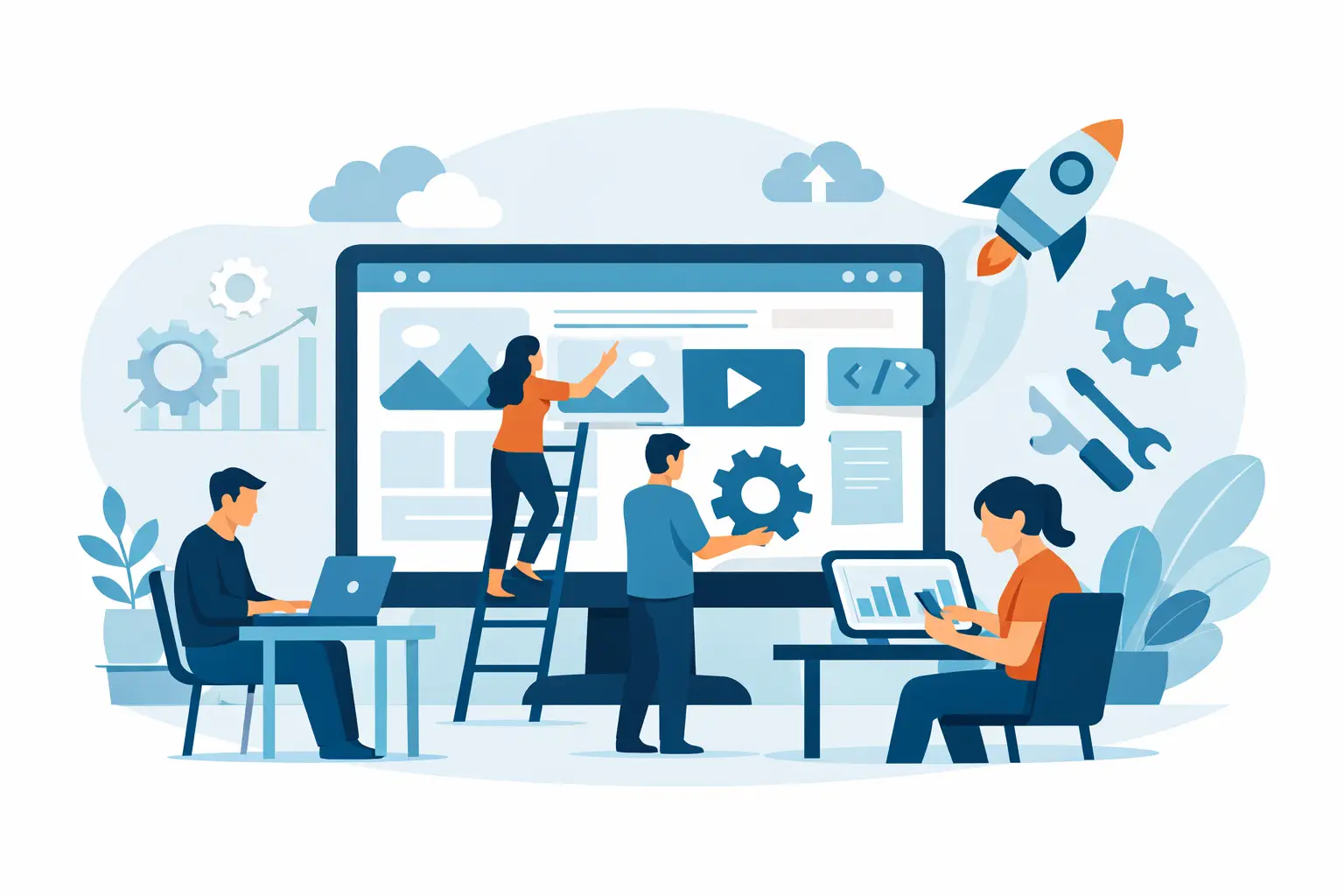
Ongoing corporate web development is something else entirely. It means maintaining constant oversight of your digital ecosystem—website, landing pages, forms, CRM integrations, automations, tracking, speed, UX, and conversion. You’re not working just to publish something once. You’re working to continuously improve what’s supposed to deliver results.
This approach also changes the criteria for evaluation. A website isn’t evaluated because it looks good, but because it converts. A landing page isn’t approved because it “looks good,” but because it lowers the cost per lead. Automation isn’t implemented because it’s innovative, but because it reduces manual work and helps ensure fewer opportunities slip through the cracks.
Why the one-time model stops working so quickly
The classic “closed” project almost always meets the same fate. After launch, new requirements arise, but every change becomes a negotiation. An extra page, a form that needs to be redesigned, a connection to the CRM, tracking that needs to be fixed, a campaign that needs to be aligned with the site. Every change involves long lead times, extra costs, and uncertain priorities.
The result: many companies put things off. First, they delay improving their landing page. Then they leave an ineffective form in place. Then they fail to update their offers. In the end, they find themselves with an online presence that exists in name only but is commercially weak.
The problem isn't just technical. It's economic. If a website receives traffic but has a low conversion rate, you're already paying the price for that inefficiency. If you run ads without a website structure that adapts quickly to data, every euro you invest performs worse than it should. If leads come in but aren't managed properly, the damage spills over into sales.
Ongoing Corporate Web Development and Revenue
Let’s be clear about this: digital initiatives shouldn’t be judged by the number of pages published, but by their impact on revenue. That’s why ongoing corporate web development makes the most sense when it’s linked to marketing, conversion, and business processes.
A company that quickly updates its offers, messages, calls to action, and user journeys has a direct advantage. It can test sooner, make corrections sooner, and monetize sooner. On the other hand, companies that rely on sporadic suppliers or makeshift solutions face a constant bottleneck.
Let's look at a typical scenario. You launch a Google Ads campaign. You're getting clicks, but the landing page is slow, the form is confusing, and there's no automatic follow-up. You don't have a traffic problem. You have an infrastructure problem. And it's a problem that can't be solved with a facelift once a year.
What Should a Serious Long-Term Job Include?
When it comes to continuity, simply promising support isn't enough. Real action is needed. This means addressing factors that affect performance and management, not just limiting ourselves to basic technical maintenance.
A serious, ongoing project includes rapid updates to the website and landing pages, optimization of conversion paths, tracking monitoring, speed improvements, integration with CRM and marketing tools, lead automation and follow-ups, adapting pages to active campaigns, and support when the business changes direction.
Then there’s an aspect that’s often overlooked: prioritization. A company doesn’t just need someone who knows how to develop software. It needs a partner who knows what to fix first in order to make an impact on the business. A change to the menu rarely alters the results. A better form, a well-organized pipeline, or a landing page created For a specific campaign, they certainly can.
The Real Benefits for SMEs, Professionals, and Local Businesses
For many Italian companies, the problem isn’t a lack of ambition. It’s a lack of structure. It doesn’t make sense to hire an in-house team consisting of a developer, a marketer, a media buyer, and an automation specialist if the volume doesn’t yet justify it. But neither does standing still or relying on suppliers who aren’t coordinated with one another.
That’s why the ongoing model is effective. It gives you access to operational expertise without burdening you with disproportionate fixed costs. You get financial predictability, faster turnaround times, and an ecosystem that evolves without having to start from scratch every time.
For a professional, it means stopping chasing technical details and focusing on negotiations. For an SME, it means having a website and a sales funnel that can scale with the business. For a local business, it means turning online visibility into manageable leads, rather than just “being there” on Google.
When In-House Web Development Alone Isn't Enough
Let's be blunt: technical continuity alone doesn't work miracles. If the offering is confusing, the pricing is off, or the sales team isn't following up on leads, a new section on the website won't solve the problem.
The strength of a continuous approach lies precisely here: it allows us to link technology and strategy, rather than treating them as separate worlds. But results come when the website, the campaigns, CRM and contact management work toward the same goal.
That’s why it’s best to be wary of both purely technical providers and marketers who think only about clicks. If no one oversees the entire process, gaps will inevitably arise. And online, those gaps come at the cost of lost leads.
How to Tell If Your Company Needs It Right Away
There are very clear signs. If it takes weeks to update a page, you’re already too slow. If your website isn’t keeping up with your active campaigns, you’re wasting traffic. If you’re collecting leads but don’t have automation or well-organized processes in place, you’re leaving money on the table. If every change requires a new quote, you have a model that’s holding back growth.
Even a seemingly new website can be ineffective. The age of the project matters less than its ability to adapt. A website launched eight months ago but never optimized may perform worse than a simpler site that is updated every week.
This is where a shift in mindset comes into play. You need to stop asking yourself how much it costs to build a website and start asking yourself how much it costs you to have a digital system that doesn't evolve.
The real comparison isn't between agencies, but between models
The choice isn't simply between one provider and another. It's between two approaches. On one hand, there's the project-based model: you pay, you receive the service, and then every request becomes a new problem. On the other hand, there's the ongoing model: you have an external team that keeps everything you need to acquire and manage customers online up and running.
The first model may make sense in very limited cases—for example, for a static showcase website with virtually no requirements. But as soon as lead generation, advertising, testing, CRM, and automation come into play, that model begins to show all its flaws.
An approach like WebWakeUp’s starts precisely from this reality: digital technology isn’t just a file you hand over—it’s a system that needs to be managed. And if the system affects revenue, neglecting it without strategic maintenance is a false economy.
The right question, then, isn’t whether continuity is worth it. The question is how much it’s already costing you not to have it. Every day that your website isn’t being improved, your processes remain manual, and your campaigns target weak pages, you’re not just putting off an upgrade. You’re handing over market share to those who act before you do.
If you want digital initiatives to stop taking up space and start producing results, treat them for what they really are: a business function that needs to be monitored, improved, and made to deliver consistently.