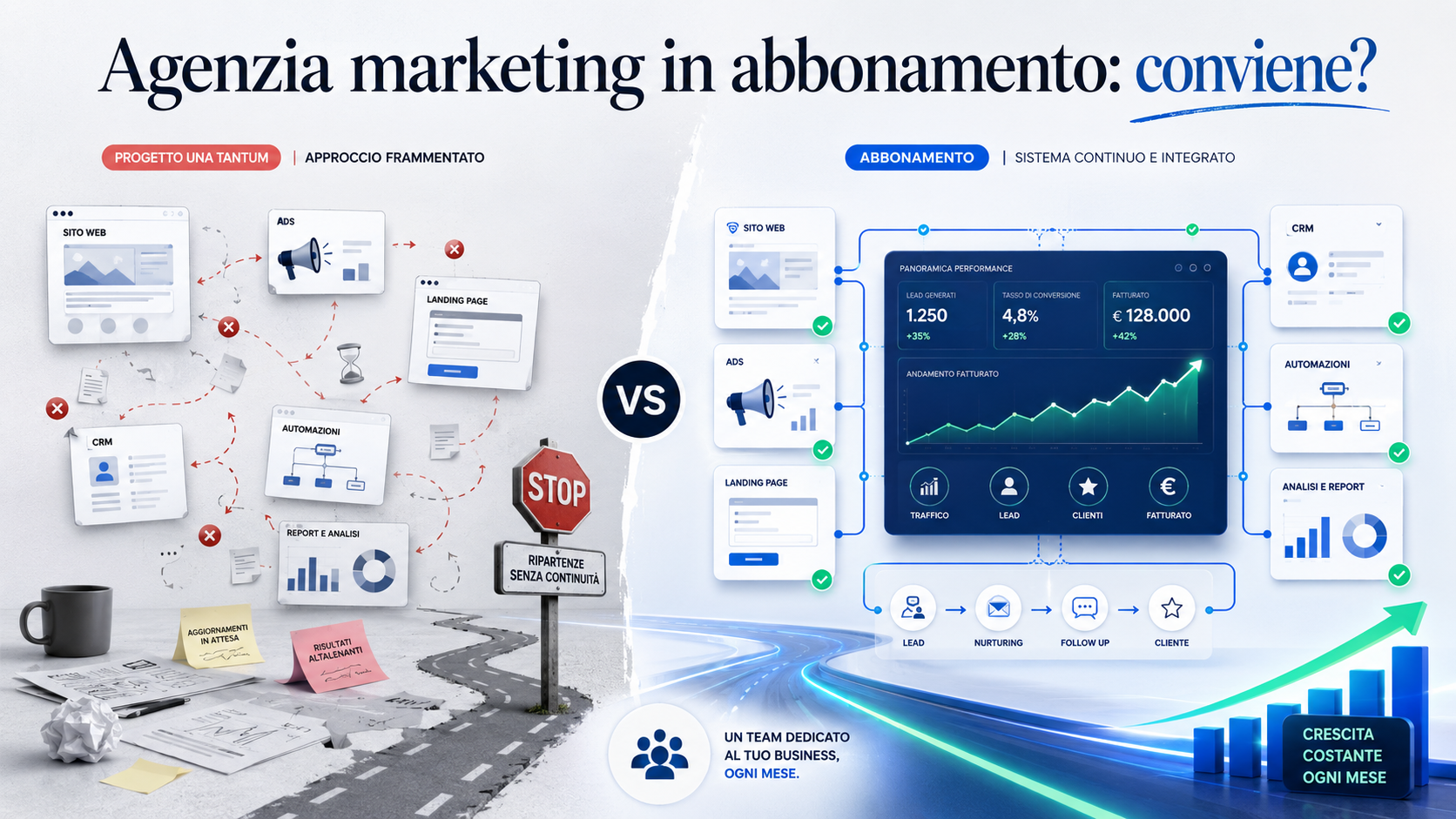
If your marketing today relies on a website that’s been inactive for months, campaigns that run sporadically, and requests handled manually, the problem isn’t the market. The problem is that you lack a system. And this is where the subscription-based marketing agency model completely changes the game.
For many small and medium-sized businesses and local enterprises, digital solutions are still purchased piecemeal. First, a website. Then, perhaps, ads. Then a landing page. Then a CRM when the chaos becomes unmanageable. The result: you spend more than necessary, work less efficiently, and lack consistency. Each vendor does their part, but no one truly oversees your growth.
A subscription-based agency was created to address exactly this: transforming marketing from a one-off expense into an ongoing operational function. You don’t just buy a project and hope that’s enough. You sign up for a monthly service that combines execution, optimization, and support.
What Does a Subscription-Based Marketing Agency Really Mean?
The concept is simple, but it’s often explained poorly. It doesn’t mean paying a monthly fee for a website. Nor does it mean getting a standard package with three social media posts and two calls a month. That’s just repackaging old services in a different format.
A true subscription-based marketing agency operates like an external department. It focuses on building and evolving the digital infrastructure you need to generate leads, convert them, and avoid wasting time on unnecessary processes. This model can include websites, landing pages, sales funnels, advertising, tracking, automation, CRM, chatbot, technical maintenance, and rapid response services.
There is just one key difference from a traditional agency: it doesn’t disappear once the project is delivered. It continues to work on the system, making corrections, updating it, and adapting it to the evolving needs of your business.
Why this model is growing
Because, in practice, the traditional model overlooks the most important aspect: continuity. A published website doesn’t generate results on its own. An ad campaign isn’t enough if the landing page doesn’t convert. An extra lead is of little use if no one follows up with it in a timely manner or if there’s no automated follow-up system in place.
Digital marketing works best when the different components work together. And that almost never happens when each service is purchased separately.
Companies are realizing a very practical truth: having different vendors for development, marketing, and automation no longer provides control. It often leads to slower processes, more finger-pointing, and more hidden costs. A subscription model, if structured properly, aligns technical execution, visibility, and conversion.
For an entrepreneur, this means one thing: less wasted effort and more speed.
When is it really worth it?
This is a good option when you need to grow your online presence but don’t want to build an in-house team. Hiring a marketer, a web designer, a media buyer, and an automation specialist costs much more than many people realize. And we’re not just talking about salaries. We’re talking about the time involved in recruitment, coordination, management, and the risk of errors.
It’s also a good fit when your business requires frequent changes. If every time you need to update a page, launch a campaign, or change a funnel, you have to go through the process of requesting quotes, getting approvals, and dealing with delays, you’re slowing down your revenue growth. A monthly subscription makes sense precisely because it reduces operational friction.
Finally, it’s a good choice when you want financial predictability. A recurring investment is easier to understand, plan for, and compare with results. It doesn’t eliminate risk, but it makes it more manageable than a large upfront investment with uncertain returns.
When it's not worth it
It’s not the right solution for everyone. If you’re just looking for a showcase website that you can launch once and leave untouched for three years, the subscription is likely to be overkill. If you don’t yet have a clear offering, sustainable margins, or even basic sales capabilities to handle inquiries, no agency can work miracles.
There’s also another point that many people overlook: the subscription model works if there’s ongoing work to be done. If the partner simply delivers the initial asset and then sits back and waits, you’re not buying continuity. You’re just paying for a project in installments.
That is why the deciding factor is not just the monthly price. It is the service's operational capacity.
The Real Comparison: Subscription vs. One-Time Project
People like one-time projects because they seem simpler. You pay, you get what you need, and it’s done. On paper, it’s straightforward. In reality, it’s often a false economy.
Let’s take the example of a company that invests in a new website. The site goes live—it’s clean, well-designed, maybe even attractive. But after launch, what almost always happens occurs: no one updates the pages, the forms aren’t optimized, tracking remains incomplete, campaigns are delayed, and CRM integrations don’t get off the ground. The project is there, but it isn’t working.
A subscription model operates on a different logic. It doesn’t view the deliverable as an end goal, but as a starting point. If a landing page has low conversion rates, it’s modified. If traffic is low, adjustments are made to ads or SEO. If leads are lost, the follow-up is automated. The value doesn’t lie in the delivered product. It lies in the ability to continuously improve it.
This doesn’t mean that one-off projects are always a bad idea. In some cases, they make sense. But anyone thinking in terms of customer acquisition and business growth will eventually run into the same problem: without continuity, results will stall.
What to Consider Before Choosing a Subscription-Based Marketing Agency
You have to keep a cool head here. Many offers seem appealing until you actually look into what they entail.
The first thing to consider is the scope of their services. If the agency handles only communications but not development, tracking, or automation, be prepared to bring in other vendors. And when other vendors get involved, delays, finger-pointing, and a lack of accountability are sure to follow.
The second is the speed of response. The real benefit of the subscription isn’t having a monthly call. It’s knowing that when a page needs to be corrected, launch a campaign or streamline a process—some people do it without turning every request into a new mini-project.
The third factor is the measurement framework. If the report is based on vague metrics, the risk is high. You need to understand which metrics you’ll be tracking: leads, cost per acquisition, conversion rate, response times, traffic quality, and the value of the leads generated. Without these, the subscription becomes nothing more than a nicely packaged recurring expense.
Finally, consider the big picture. A good partner doesn’t just sell you individual tools. They help you build an ecosystem. Your website, advertising, sales funnel, CRM, and automation tools need to work together as a single, integrated system.
The point that many people overlook: time
When an entrepreneur says, “I’ll handle it myself,” they’re almost always underestimating the value of their own time. Every hour spent coordinating freelancers, chasing down technicians, or figuring out why a campaign isn’t tracking properly is an hour taken away from sales, operations, or business development.
Do-it-yourself isn’t cost-effective if it slows down the business. And a traditional agency isn’t efficient if it only operates in fits and starts. The reason the subscription model is gaining traction is simple: it reduces the downtime between a problem and its solution.
For a company that wants to stay competitive, this matters more than the initial quote. Because online, success doesn’t go to those who get it right the first time. It goes to those who correct, test, and respond the fastest.
A model that only makes sense if it is revenue-driven
Let’s be clear about this. If a subscription-based marketing agency focuses solely on creativity, online presence, and content without tying its work to business goals, there’s a problem. You don’t need a subscription to tasks. You need a system that drives business results.
That’s why the best model is one that combines technical and marketing aspects. It’s not just about traffic, but conversion. It’s not just about the website, but the sales funnel. It’s not just about leads, but lead management. It’s not just about campaigns, but tracking and optimization.
That is also why companies like WebWakeUp are pushing for a more integrated approach: rather than selling a standalone solution, they provide an external team that remains active and works every month on customer acquisition, efficiency, and operational continuity.
So the right question isn’t whether a subscription costs more or less than a one-off project. The right question is this: how much is it costing you today not to have a digital system that works every day to bring you leads and turn them into customers?
If the answer is “more than I’d care to admit,” then you probably don’t need another provider. You need a partner that doesn’t just deliver—one that helps you keep growing what you’ve built.